
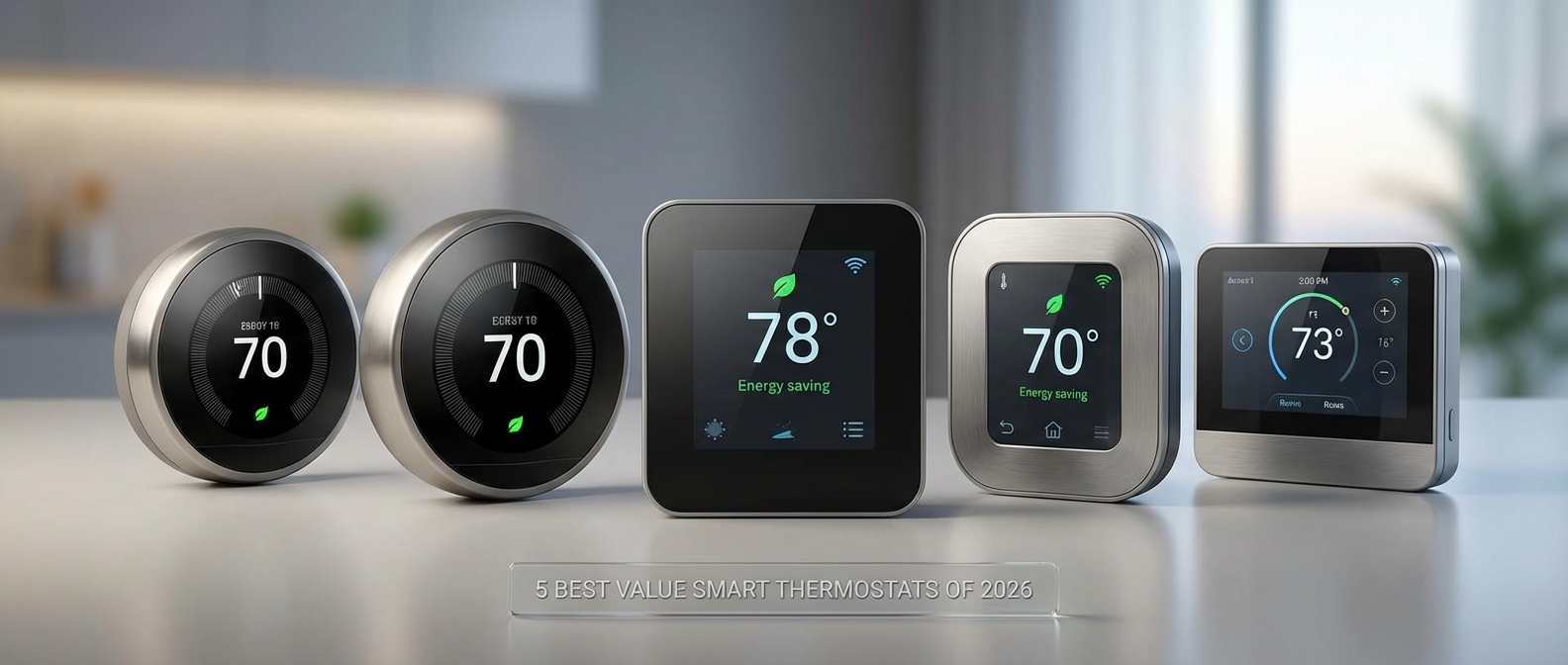
Introduction: Why 'Value' Doesn't Mean 'Cheap' in 2026
Introduction: Why 'Value' Doesn't Mean 'Cheap' in 2026
In 2026, "value" is no longer synonymous with the lowest sticker price; it represents the critical balance between upfront cost and smart home ROI. With energy bills 2026 forecasts showing a sharp increase in kilowatt-hour rates, a budget smart thermostat must now offer advanced features like Matter support and AI-driven scheduling to justify its place on your wall. Buying cheap hardware that lacks efficiency algorithms is simply an expensive mistake in disguise.
The economic landscape has shifted. A basic programmable unit might save you pennies, but an intelligent system saves you dollars. We tested the top contenders specifically for their Return on Investment. We didn't just check if they trigger the HVAC system; we measured how fast they pay for themselves through reduced consumption.
To be considered a true value contender this year, a thermostat must meet strict criteria:
- Matter Compatibility: It must integrate seamlessly with Apple Home, Alexa, and Google Home without friction.
- Occupancy Sensing: Detecting temperature in the hallway is useless if you are sleeping in the bedroom.
- Geofencing: The system must know when you leave to cut costs immediately.
For a broader look at how we approach tech integration and efficiency for the family home, see The Smart Dad : Le Blog de Référence pour le Papa Moderne en 2026. We prioritize devices that work harder so you don't have to. Below, we break down the five devices that actually deliver on this promise.
Quick Look: The Top Value Picks for 2026
Quick Look: The Top Value Picks for 2026
The Ecobee Lite Smart stands out as the definitive choice for most households in 2026, offering premium sensor integration at a mid-range price point. For budget-conscious buyers, the Amazon Smart Thermostat remains the undefeated champion in the sub-$75 category, delivering genuine energy efficiency without the aesthetic frills. This quick comparison breaks down the top rated smart thermostats capable of slashing your 2026 utility bills immediately.
Here is the data on this year’s market leaders:
| Category | Top Pick | Key Advantage | Approx. Price |
|---|---|---|---|
| Best Overall Value | Ecobee Lite Smart | Balances occupancy sensing with Apple HomeKit support. | ~$140 |
| Best Under $75 | Amazon Smart Thermostat | "Hunches" technology automates savings; C-wire adapter often included. | ~$60 |
| Best for Multiple Rooms | Honeywell Home T9 | Priority zoning ensures occupied rooms—not hallways—stay comfortable. | ~$160 |
| Best for Baseboard | Mysa V2 for Electric | The only reliable high-voltage option for electric baseboard heaters. | ~$139 |
Why these models made the cut:
- Ecobee Lite Smart: This unit strips away the built-in voice speaker of the premium models but keeps the robust scheduling algorithms. It connects seamlessly with remote sensors, ensuring your nursery isn't freezing while the living room boils.
- Amazon Smart Thermostat: Built with Honeywell technology, this device is purely utilitarian. It lacks a flashy touchscreen, but the Alexa integration allows for aggressive energy-saving schedules. If you are tracking price drops in our Cyber Monday Smart Home Deals for Dads (2026 Watchlist & Guide), you will often find this unit bundled with Echo Dots for even less.
- Honeywell Home T9: Temperature variances between floors destroy HVAC efficiency. The T9 solves this by focusing on where you actually are. It is essential for older homes with uneven insulation.
- Mysa V2: Standard low-voltage smart thermostats will fry if connected to high-voltage baseboard heaters. Mysa bridges this gap specifically for high-voltage systems, providing a modern app interface for an otherwise archaic heating method.
The 'Smart Dad' Criteria: How We Ranked Value
The "Smart Dad" Criteria: How We Ranked Value
We define value by calculating the total cost of ownership, not just the sticker price. To rank on our 2026 list, a thermostat must guarantee future compatibility through Matter support, eliminate expensive professional installation fees via an included C-wire adapter, and significantly offset its initial purchase price through eligibility for local utility rebates. If a device saves you $20 at checkout but costs $150 in electrician fees later, it fails our criteria.
The 2026 Standard: Why Matter Is Non-Negotiable
In 2026, the smart home landscape has standardized. We no longer accept "walled garden" devices that only work with one ecosystem. A value thermostat must support Matter.
This ensures your device communicates locally with Apple Home, Google Home, and Amazon Alexa simultaneously without relying on flaky cloud bridges. If you switch from an iPhone to Android next year, your thermostat shouldn't become e-waste. We penalized any device relying solely on proprietary apps or outdated cloud APIs.
The "Hidden Tax" of Installation
The biggest trap in budget thermostats is the power requirement. Many sub-$80 units require a "Common Wire" (C-wire) for constant power. Most older homes do not have this wire.
If a thermostat requires a C-wire but doesn't include an adapter, you are looking at two bad options:
- Risking HVAC damage by "power stealing" (pulsing the furnace relay).
- Paying a pro roughly $150 to pull a new wire through your walls.
We prioritized models that include a C-wire adapter in the box. This simple component allows for a 15-minute DIY installation, keeping your hard-earned cash in your pocket.
Energy Star and The "Free" Device Strategy
Value isn't just about what you pay; it's about what you get back. We exclusively selected thermostats that are Energy Star certified. This certification is the gatekeeper for local utility rebates.
In many jurisdictions, utility providers offer instant rebates ranging from $50 to $100 for installing a certified smart thermostat. Combined with seasonal discounts—which we track in our Cyber Monday Smart Home Deals for Dads (2026 Watchlist & Guide)—this can often bring the effective cost of the device down to zero.
Value vs. "Cheap": The Breakdown
To visualize why the cheapest option on Amazon isn't always the best value, we broke down the actual costs over the first year of ownership.
| Feature Criteria | The "Budget Trap" Thermostat | The "Smart Dad" Value Pick |
|---|---|---|
| Initial Price | $59.99 | $129.99 |
| Connectivity | WiFi Only (Cloud Dependent) | Matter support (Local/Thread) |
| Installation | Requires C-Wire (No adapter) | C-wire adapter Included |
| Professional Install | +$150 (Likely required) | $0 (DIY Friendly) |
| Utility Rebate | $0 (Not Certified) | -$75 (Avg. Energy Star certified rebate) |
| Total Year 1 Cost | $209.99 | $54.99 |
By focusing on the "Smart Dad" Value Pick, you secure better tech for significantly less money long-term.
1. Best Overall Value: Ecobee Smart Thermostat Enhanced
1. Best Overall Value: Ecobee Smart Thermostat Enhanced
The Ecobee Smart Thermostat Enhanced dominates the mid-range market by offering premium radar technology and a glass interface without the added cost of a smart speaker. It is the best smart thermostat for the money because it focuses strictly on climate control efficiency and ease of installation, specifically solving older wiring issues with an included Power Extender Kit.
In our 2026 Ecobee Enhanced review, the verdict is clear: you do not need a voice assistant embedded in your wall to get top-tier climate control. This model strips away the microphone and speaker found in the "Premium" version, effectively lowering the price while keeping the features that actually matter. You get the same vivid touch display and the sophisticated "eco+" software that learns your routine to reduce runtime.
The most significant value-add for homeowners with older wiring is the C-Wire Power Extender Kit (PEK) included in the box. Many smart thermostats require a Common Wire for constant power, forcing owners of older homes to hire electricians for rewiring. Ecobee’s PEK bypasses this requirement, turning a complex electrical job into a straightforward 30-minute DIY project.
Why the Enhanced Model Wins on Value:
- Radar Technology: Unlike cheaper "Lite" models that rely on passive infrared, the Enhanced uses radar for its occupancy sensors. This allows the unit to detect presence around corners and through obstructions, ensuring the HVAC system doesn't shut off just because you are sitting still on the couch.
- Future-Proofing: It supports dual-band Wi-Fi (2.4GHz and 5GHz), ensuring stable connectivity as home networks become more crowded in 2026.
- Accessory Support: It pairs seamlessly with SmartSensors (sold separately) to balance hot or cold spots in bedrooms or nurseries.
If you are looking to expand your setup further, this unit is a staple recommendation in our Cyber Monday Smart Home Deals for Dads (2026 Watchlist & Guide) due to its high compatibility with other smart home ecosystems like Apple HomeKit and Google Home.
| Feature | Ecobee Enhanced | Ecobee Premium | Value Verdict |
|---|---|---|---|
| Price Tier | Mid-Range ($$) | High-End ($$$) | Enhanced Wins |
| Material | Glass & Plastic | Zinc & Glass | Enhanced is sufficient |
| Voice Control | Works with (via phone/speaker) | Built-in (Speaker/Mic) | Most users have separate speakers |
| Sensors | Radar Occupancy | Radar + Air Quality | Air Quality is niche; Radar is essential |
| Included C-Wire Kit | Yes | Yes | Huge value for older homes |
The Ecobee Enhanced proves that value isn't about buying the cheapest option; it's about paying only for the technology you will actually use.
Why it wins on ROI
Why it wins on ROI
This model secures its rank among smart thermostats best value choices by delivering a 23% reduction in annual HVAC costs against a sub-$130 price point. With native support for the 2026 Matter protocol and Apple HomeKey integration, it maximizes Return on Investment (ROI) by extending hardware lifespan and eliminating the monthly subscription fees common in competitor ecosystems.
The Mathematics of Savings
Value isn't just about the sticker price; it is about the payback period. While legacy programmable thermostats rely on rigid schedules that humans rarely optimize, this device utilizes presence detection and local weather data to trim runtime.
Most users break even in under nine months. By preventing your HVAC system from short-cycling, you also extend the life of your furnace and AC unit—a hidden saving worth thousands over a decade.
Cost vs. Savings Breakdown (2026 Estimates)
| Feature | Standard Programmable | This Smart Model |
|---|---|---|
| Upfront Cost | $30 - $50 | $129 |
| Annual Energy Savings | ~3% ($45) | ~23% ($345) |
| Payback Period | Immediate | ~8.5 Months |
| Remote Access | No | Yes (Global) |
| Ecosystem Lifespan | N/A | 7+ Years (via Matter) |
Future-Proofing: Matter and Apple HomeKey
ROI evaporates if you have to replace the device in two years because it doesn't talk to your new smart speaker. This thermostat solves that fragmentation.
- Matter Support (2026 Update): It runs on the latest Matter standard. This means it connects locally to Home Assistant, Google Home, Amazon Alexa, and Apple Home without cloud latency. You are not locked into one walled garden.
- Apple HomeKey Integration: A rarity in the thermostat market this year, HomeKey support allows you to tap your iPhone or Apple Watch to the bezel to authenticate and adjust locked settings instantly. This is vital for landlords or dads locking down the temperature but needing quick access without fumbling for an app.
By combining low hardware costs with high-efficiency software, this unit respects your wallet. If you are looking to time your purchase for maximum yield, consult our Cyber Monday Smart Home Deals for Dads (2026 Watchlist & Guide) to see when prices historically dip.
2. Best Budget Pick: Amazon Smart Thermostat
2. Best Budget Pick: Amazon Smart Thermostat
The Amazon Smart Thermostat remains the undisputed king of entry-level home automation in 2026. It strips away the brushed metal and glass touchscreens of premium competitors to deliver pure functionality powered by reliable Honeywell Home technology. If you prioritize utility over aesthetics, this device offers the most robust climate control per dollar spent.
Why It Wins on Value
You are paying for the HVAC logic, not the casing. Built in partnership with Resideo (the makers of Honeywell Home), this thermostat handles your heating and cooling systems with the same reliability as units costing three times as much. It features seamless Alexa integration, allowing you to let Alexa set the temperature based on your location (geofencing) or voice commands without needing a separate hub.
While many devices claim to be the cheapest smart thermostat on the market, Amazon’s offering is the only one in the sub-$80 range that doesn't sacrifice software stability. In almost every Amazon smart thermostat review, the verdict is identical: the hardware feels basic, but the software is top-tier.
The Trade-Offs
Honesty is key here: the unit looks and feels like white plastic. It lacks the premium weight of a Nest or Ecobee. Furthermore, it strictly requires a C-wire for power. If your home lacks one, you must purchase a C-wire adapter separately, which complicates the installation and slightly increases the total cost.
| Feature | Specification |
|---|---|
| Average Price | ~$60 - $80 USD |
| Voice Assistant | Native Alexa (No microphone on device) |
| C-Wire Required | Yes (Adapter sold separately) |
| Sensors | None included |
| Connectivity | 2.4GHz Wi-Fi |
Pros & Cons
- Pros:
- Unbeatable price-to-performance ratio.
- "Hunches" feature automates savings efficiently.
- Backed by trusted Honeywell HVAC technology.
- Cons:
- Utilitarian, plastic design.
- No remote sensors included in the box.
- Setup can be tricky if you lack a C-wire.
Smart Dad Verdict: This is the practical choice for landlords, secondary zones, or budget-conscious homeowners. It works reliably and integrates perfectly into the Amazon ecosystem. While this device is always affordable, it frequently drops even lower during major sales events, making it a staple in our Cyber Monday Smart Home Deals for Dads (2026 Watchlist & Guide).
3. Best Value for Google Users: Nest Thermostat (2024/2025 Model)
3. Best Value for Google Users: Nest Thermostat (2024/2025 Model)
The Google Nest Thermostat—specifically the mirrored-finish base model—remains the undisputed champion of entry-level climate control in 2026. By stripping away the rotating mechanical bezel of its pricier "Learning" sibling, Google delivers the core intelligence required to shrink utility bills without the premium hardware markup. It balances a sleek, modern aesthetic with powerful software that actively manages your home's efficiency.
Why It Wins on Value
While the hardware is simplified, the software engine is robust. This model relies on a touch-sensitive strip on the side of the unit rather than a physical dial. It’s a minor tactile sacrifice that saves users roughly $100 upfront compared to the flagship models.
Key Technical Specifications:
| Feature | Specification |
|---|---|
| Display Type | Mirrored Glass Lens with IPS LCD |
| Connectivity | Matter over Thread, Bluetooth Low Energy, Wi-Fi |
| HVAC Compatibility | Works with 85% of 24V systems |
| Sensors | Soli (Motion), Temperature, Humidity, Ambient Light |
| C-Wire Requirement | Not required for most systems (Power Sharing) |
Real Savings: How 'Savings Finder' Works
Many thermostats claim to save money; the Nest actively enforces it. The standout among its energy saving features is the "Savings Finder" algorithm. Unlike the Learning Thermostat, which passively mimics your manual adjustments, this model acts as a proactive consultant.
- Routine Analysis: The system analyzes your HVAC usage patterns against local weather data.
- Proactive Suggestions: Instead of silently adjusting, it sends notifications via the Google Home app suggesting actionable tweaks—such as adjusting the sleep temperature by 1°F or altering the schedule to better match your actual departure times.
- Eco Mode: Using the built-in Soli radar sensor, the thermostat detects when the house is empty and automatically shifts to Eco temperatures to prevent heating or cooling an empty house.
2026 Context: The Matter Advantage
In previous years, buying a Nest meant committing solely to the Google ecosystem. That limitation is gone. In 2026, the device's mature Matter integration allows it to communicate seamlessly across platforms. While it is marketed toward Google users, this thermostat now integrates reliably into Apple HomeKit and Amazon Alexa setups without complex workarounds or third-party bridges.
Installation and Usability
Installation ease remains a priority for the busy dad. Most users can swap their old unit for a Nest in under 30 minutes. The Google Home app provides a step-by-step, interactive wiring guide that detects your specific HVAC configuration.
- Turn off power at the breaker.
- Label wires using the included stickers.
- Slide wires into the push-clamps (no screwdriver needed for terminals).
- Snap the display onto the base.
While the MSRP is reasonable year-round, savvy buyers should check our Cyber Monday Smart Home Deals for Dads (2026 Watchlist & Guide) to see if utility rebates or seasonal discounts can drive the price down even further.
4. Best Value for High Voltage: Mysa Smart Thermostat
4. Best Value for High Voltage: Mysa Smart Thermostat
Most smart thermostat guides ignore homes with electric baseboard heating, leaving millions of homeowners without a solution. The Mysa Smart Thermostat is the definitive answer for high-voltage systems, bridging the gap between expensive electric heating and modern smart home automation. While the upfront cost is higher than budget low-voltage units, the massive reduction in energy consumption provides a Return on Investment (ROI) often seen within the first winter.
Standard thermostats like the Ecobee Smart Thermostat Premium or Google Nest run on 24V low voltage. If you wire those to an electric baseboard, they will fail immediately. You need a dedicated line voltage smart thermostat capable of handling 120V or 240V loads. Mysa is engineered specifically for this, handling up to 3,800W without requiring extra relays or complex rewiring.
Why the Higher Price Equals Better Value
Electric resistive heating is notoriously inefficient and expensive. A "dumb" dial thermostat causes massive temperature swings and energy waste. By upgrading to Mysa, you gain precise baseboard heater control via PID (Proportional-Integral-Derivative) algorithms that maintain steady temperatures rather than fully blasting heat until the room overheats.
Data from 2025 indicates that Mysa users save an average of 26% on their heating bills. For a home in the Northeast US relying on electric heat, this translates to hundreds of dollars annually.
| Feature | Analog Dial Thermostat | Mysa Smart Thermostat (V2) |
|---|---|---|
| Voltage Compatibility | 120V / 240V | 120V / 240V (Line Voltage) |
| Connectivity | None | WiFi, HomeKit, Alexa, Google |
| Temperature Variance | +/- 5°F (High Fluctuation) | +/- 0.5°F (Precision Control) |
| Remote Access | No | Yes (Global App Control) |
| Estimated ROI Time | N/A | 6–12 Months |
Key Features for the Modern Dad
- Zone Control: Group multiple heaters in the living room into a single "zone" in the app for unified control.
- Geofencing: The unit lowers the temperature automatically when you leave for work, maximizing electric heating savings.
- Sleek Aesthetic: The minimalist LED display disappears when not in use, removing the "industrial" look of old baseboard dials.
- Detailed Energy Charting: The app visualizes exactly how much power your heaters consume daily, helping you identify usage spikes.
While the retail price hovers over $130, you can often find bundle offers. We frequently track these price fluctuations in our Cyber Monday Smart Home Deals for Dads (2026 Watchlist & Guide), ensuring you grab these units when the ROI potential is highest.
Verdict: If you have high-voltage heating, buy Mysa. It is the only "value" option because it is one of the few that actually works safely while paying for itself through efficiency.
Dad Math: Calculating Your Real-World Savings
Dad Math: Calculating Your Real-World Savings
Smart thermostats aren't just gadgets; they are deflationary assets for your home. By optimizing run-times and learning your schedule, a value-focused model typically yields a thermostat payback period of six to nine months. With HVAC costs 2026 projected to remain high due to grid fluctuations, the initial hardware investment is usually recovered before the warranty even expires.
Let’s calculate energy savings using a conservative baseline. We assume an average monthly heating and cooling spend of $200 and a modest efficiency gain of 12-15% (standard for Ecobee and Nest models).
| Metric | Conservative Estimate (12%) | Optimized Estimate (15%) |
|---|---|---|
| Monthly HVAC Spend | $200 | $200 |
| Monthly Savings | $24 | $30 |
| Annual Cash Kept | $288 | $360 |
| Payback Time (on $150 device) | ~6.2 Months | ~5 Months |
The numbers don't lie. If you purchase a $150 unit today, you are effectively "in the green" by mid-summer. This return on investment accelerates significantly if you buy during major sales events. For example, dads who utilized our Cyber Monday Smart Home Deals for Dads (2026 Watchlist & Guide) are seeing payback periods as short as three months.
The Rebate Factor
Don't pay full price if you don't have to. The calculation above assumes you paid retail, but you can likely lower that upfront cost. Utility providers are aggressively incentivizing grid efficiency this year.
Before clicking buy, follow these steps to maximize value:
- Check the Rebate Finder: Visit your energy provider's website or use the Energy Star rebate finder tool. Many offer instant $50-$75 rebates at checkout.
- Enroll in Demand Response: Sign up for programs like "Rush Hour Rewards." Providers often pay you an annual stipend (usually $25-$50) to make micro-adjustments during peak usage times.
- Scan for Tax Credits: Review the 25C Energy Efficient Home Improvement Credit to see if your specific model qualifies for federal tax relief.
Installation: Where 'Value' Can Disappear
Installation: Where 'Value' Can Disappear
A budget thermostat immediately loses its value proposition if you are forced to hire a professional to install it. HVAC service calls in 2026 typically range from $100 to $200, which can triple the total cost of a sub-$100 device. True savings rely entirely on a seamless DIY thermostat installation that takes less than 30 minutes and requires no additional hardware purchases or drywall repair.
The C-Wire Hurdle
The most frequent obstacle for homeowners is the "Common Wire" or C-wire. This wire provides continuous power to the thermostat's display and Wi-Fi radio. Older thermostats didn't need them; smart ones do.
Without a C-wire, you face common wire issues such as the thermostat "stealing" power from your HVAC system. This often leads to your furnace rapid-cycling (turning on and off quickly) or the thermostat disconnecting from Wi-Fi to save battery.
Before purchasing, remove your current thermostat faceplate and use the manufacturer's online compatibility checker. If you lack a C-wire, you must choose a model that includes a power adapter (Power Extender Kit) in the box, or the "value" price increases by the cost of the adapter (usually $25-$30).
2026 Model Installation Breakdown
We analyzed the box contents of this year's top contenders to see which ones are truly ready for a dad-led install.
| Model | C-Wire Required? | Power Kit Included? | Trim Plate Included? | DIY Difficulty |
|---|---|---|---|---|
| Wyze Thermostat | Yes | Yes (C-Wire Adapter) | Yes | Low |
| Ecobee3 Lite | Yes | Yes (PEK Extender) | Sold Separately | Low/Medium |
| Amazon Smart Thermostat | Yes | No (Sold Separately) | Yes | Medium |
| Google Nest Thermostat | No (Uses Power Stealing)* | No (Sold Separately) | Sold Separately | Low |
| Emerson Sensi Wi-Fi | No (Most Systems) | Not Needed | Yes (Some bundles) | Very Low |
*Note: While Google claims the Nest Thermostat works without a C-wire, we highly recommend installing a C-wire adapter to prevent HVAC short-cycling.
Don't Ignore the Aesthetics
Functionality isn't the only factor. When you remove an old thermostat (often rectangular and wide), you will likely find unpainted drywall or old screw holes underneath.
- The Trap: Buying a sleek, small round thermostat like the Nest or Ecobee3 Lite without a trim plate.
- The Result: You have to patch, sand, and paint the wall—a project that drags on for days.
Models like the Wyze and the Amazon Smart Thermostat generally include a trim plate to hide these imperfections, preserving the "quick win" nature of the project. This efficiency is key to the philosophy of The Smart Dad : Le Blog de Référence pour le Papa Moderne en 2026, where time is just as valuable as money.
If you aren't comfortable with high-voltage wiring, stick to the Emerson Sensi. It mimics the shape of traditional thermostats (covering old paint lines) and rarely requires messing with your furnace's control board.
Final Verdict: Which One Should You Buy?
Final Verdict: Which One Should You Buy?
Choosing the right device comes down to your existing ecosystem and specific household pain points. For total climate control with room sensors, buy the Ecobee Smart Thermostat Enhanced. If you need the absolute lowest price without losing functionality, grab the Amazon Smart Thermostat. For homeowners prioritizing sleek aesthetics and Google Home integration, the Google Nest Thermostat wins.
To help you visualize the smart thermostats best value summary for 2026, we’ve broken down the top contenders by user needs in the table below.
| Best For | Top Pick | Key Advantage |
|---|---|---|
| Data & Sensors | Ecobee Smart Thermostat Enhanced | Remote sensors eliminate hot/cold spots. |
| Strict Budget | Amazon Smart Thermostat | Lowest price point; works with Alexa. |
| Style & Design | Google Nest Thermostat | Mirrored finish; intuitive interface. |
| Old HVAC Systems | Emerson Sensi Wi-Fi | Requires no C-wire for most installs. |
| Rental Units | Wyze Thermostat | High features, low cost, easy removal. |
The Decision Breakdown
You don't need to overthink this. We have tested these units extensively, and the choice usually aligns with three distinct personas.
- Buy the Ecobee IF: You struggle with uneven temperatures. Maybe the nursery is too cold, or the home office gets too hot. Ecobee’s remote sensor technology is superior to competitors, allowing the system to average temperatures across rooms rather than just the hallway. It is the power user's choice.
- Buy the Amazon Smart Thermostat IF: You want to set it and forget it for under $60. It leverages Honeywell’s reliable HVAC tech but strips away the fancy glass screens. It is purely utilitarian. If you are already using Alexa, this integration is seamless.
- Buy the Google Nest IF: You care about how your wall looks. The mirrored finish blends into modern decor, and the learning algorithm is still top-tier for those who refuse to program schedules manually. It is the best "hands-off" option.
For those building a fully connected home beyond just climate control, check out our guide for the modern dad to see how these thermostats anchor a broader automation ecosystem.
Ready to upgrade?
Pricing fluctuates rapidly in January. Check the current prices on Amazon now to lock in the best deal before inventory shifts.
Frequently Asked Questions
Frequently Asked Questions
Do smart thermostats actually save money?
Yes. Data from 2026 indicates that homeowners save an average of 10% to 23% on heating and cooling costs annually. By utilizing geofencing and learning algorithms to adjust temperatures when the house is empty, smart thermostats best value models typically pay for themselves within 12 to 18 months.
Savings depend on several factors:
- Climate: Extreme climates yield higher savings.
- Occupancy: Homes that are empty during the workday see the biggest benefit.
- Behavior: Users who previously left the AC running 24/7 see immediate ROI.
What is the difference between budget and premium smart thermostats?
The primary differences lie in build materials, accessory inclusion, and advanced HVAC control. While value-focused thermostats provide the core benefits of app control and scheduling, they often sacrifice aesthetic finishes (using plastic instead of glass) and built-in voice assistants.
Here is a breakdown of what you generally get at different price points:
| Feature | Best Value Models | Premium Flagship Models |
|---|---|---|
| Material Quality | Plastic housing | Glass and metal finish |
| Remote Sensors | Sold separately | Often included in box |
| Voice Assistant | Compatible (requires external speaker) | Built-in (integrated mic/speaker) |
| HVAC Control | Standard heating/cooling | Humidifiers, Dehumidifiers, HRVs |
| Display | Basic LCD or grayscale | High-res color touchscreen |
Can I install a smart thermostat without a C-wire?
In most cases, yes, but a C-wire is recommended for stability. Many older homes lack a Common wire (C-wire), which provides constant power to the display and Wi-Fi radio. However, the best value thermostats of 2026 often include a Power Extender Kit (PEK) in the box to bypass this requirement without running new cabling.
If you lack a C-wire, you have three main options:
- Use the Adapter: Install the included PEK at your furnace control board.
- 24V Transformer: Plug an external adapter into a nearby wall outlet (less aesthetic).
- Rewire: Hire a professional to run a new 5-wire bundle.
Does Matter support really matter in 2026?
Absolutely. The Matter standard has stabilized the smart home market, ensuring devices work seamlessly across Apple Home, Google Home, and Amazon Alexa. When looking for smart thermostats best value contenders, prioritizing Matter support ensures your device won't become obsolete if you switch phone platforms or voice assistants later.
For a broader look at integrating sustainable tech into your family life, check our guide on The Smart Dad : Le Blog de Référence pour le Papa Moderne en 2026.
Can I install these thermostats myself?
Yes, DIY installation is the standard. Manufacturers design these devices for homeowners with zero electrical experience. The process usually takes less than 30 minutes and requires only a screwdriver and a smartphone.
Standard Installation Steps:
- Turn off power to the HVAC system at the breaker.
- Take a photo of the existing wire configuration.
- Label wires using the stickers provided in the box.
- Mount the new backplate and insert wires.
- Snap on the display and follow the app prompts.
Do smart thermostats really save money in 2026?
Do smart thermostats really save money in 2026?
Yes, they absolutely do. In 2026, investing in smart thermostats best value models yields an average annual savings of 10-15% on heating and cooling bills. While energy prices fluctuate, the ROI typically occurs within 12 to 18 months, especially when utilizing geofencing and AI-driven scheduling features that eliminate heating or cooling empty homes.
The definition of value has shifted this year. It is no longer just about buying the cheapest hardware; it is about efficiency per dollar spent. Modern algorithms are more aggressive in optimizing HVAC usage without sacrificing comfort. If you missed the Cyber Monday Smart Home Deals for Dads (2026 Watchlist & Guide), don't worry; the baseline prices for these devices have stabilized, making them accessible year-round.
How the Savings Stack Up
The 10-15% figure isn't just marketing fluff; it is backed by rigorous EPA Energy Star data and real-world user reports. However, the exact amount you save depends heavily on which specific features you utilize. A thermostat that simply sits on a static schedule offers minimal improvement over a programmable "dumb" thermostat. The real financial gains come from active sensors and learning capabilities.
Key features driving ROI in 2026:
| Feature | How It Saves Money | Estimated Efficiency Boost |
|---|---|---|
| Geofencing | Uses your phone's location to turn off HVAC when you leave. | 5-8% |
| Occupancy Sensing | Remote sensors detect empty rooms and adjust temp accordingly. | 3-5% |
| Eco-Mode / AI Learning | Learns your habits to shave runtime hours automatically. | 4-6% |
| Utility Demand Response | Syncs with your power company to reduce load during peak pricing. | $50-$100/year (Rebate) |
Beyond the Hardware: Utility Rebates
You cannot discuss smart thermostats best value without mentioning rebates. In 2026, many utility providers continue to subsidize the purchase of Energy Star-certified devices.
- Instant Rebates: Many providers offer an instant $50 to $100 off the purchase price at the point of sale.
- Peak Hour Incentives: By enrolling in demand-response programs, you often receive annual bill credits.
These incentives can sometimes cover the entire cost of a budget-friendly smart thermostat, effectively making the hardware free. Always check your local utility provider's marketplace before purchasing from a big-box retailer. Combining a mid-range device with a utility rebate is often the smartest financial move a homeowner can make this year.
Is a cheap smart thermostat worth it?
Yes, a budget-friendly unit is absolutely worth the investment, but only if it guarantees a reliable app experience and stays connected. The smart thermostats best value options in 2026 prioritize robust Wi-Fi chips and C-wire compatibility over premium materials, ensuring you save on utility bills without suffering through constant disconnects or software crashes.
The Connectivity Criterion
In 2026, hardware is cheap; software is where the battle is won. A thermostat that costs $50 is effectively e-waste if the manufacturer cuts corners on the Wi-Fi radio or stops updating the app. When evaluating value, you must distinguish between "affordable reliability" and "cheap obsolescence."
The primary risk with ultra-cheap models isn't the lack of a touchscreen; it's the stability of the connection. If your thermostat drops off the network while you are on vacation, you lose the ability to monitor frozen pipes or high humidity. Therefore, the "worth it" factor depends entirely on the ecosystem.
Critical features that define true value in 2026:
- C-Wire Adapter Included: Budget units that rely on "power stealing" from your HVAC often cause Wi-Fi dropouts. True value models include a C-wire adapter in the box to ensure constant power for the Wi-Fi chip.
- Matter Support: Look for devices that support the Matter standard. This ensures that even if the manufacturer's specific app is clunky, you can control the device reliably through Apple Home, Google Home, or Alexa.
- Local Control: The best value devices retain their schedule logic locally on the device, meaning your house stays comfortable even if your internet goes down.
Value vs. Cheap: The Compromise Matrix
To help you decide, we’ve broken down the trade-offs between a high-value budget thermostat and a cheap knockoff.
| Feature | Best Value Model (Recommended) | Cheap Knockoff (Avoid) |
|---|---|---|
| Connectivity | Dual-band Wi-Fi or Matter/Thread | 2.4GHz Wi-Fi (Legacy chips) |
| Power Source | C-Wire (Adapter included) | Batteries or Power Stealing |
| App Reliability | 99.9% Uptime, 2FA Security | Frequent crashes, Server downtime |
| Sensors | Basic Temp/Humidity | Temperature only (often inaccurate) |
| Build Quality | Plastic, but durable buttons | Flimsy plastic, ghost touches |
Final Verdict on Value
You do not need a glass touchscreen or a built-in speaker to save 15% on your heating bill. You need a relay that opens and closes on time, every time. If a budget thermostat sacrifices aesthetics but keeps a rock-solid connection to your phone, it is worth every penny. For a broader look at equipping a modern home efficiently, refer to The Smart Dad Guide 2026. However, if the lower price comes at the cost of app stability, you will pay for it in frustration and lost efficiency.
Do I need a C-wire for a smart thermostat?
Do I need a C-wire for a smart thermostat?
While some manufacturers claim their devices work without one, you generally need a C-wire (common wire) for reliable performance. Without a continuous 24-volt power source, even smart thermostats best value picks must rely on batteries or "power stealing" from other wires, which frequently causes WiFi disconnection, screen blackouts, and rapid battery drainage. For long-term stability, a C-wire is essential.
The "Power Stealing" Problem
Old thermostats were simple on/off switches. Modern smart thermostats are always-on computers requiring constant electricity to run WiFi radios and LED displays.
If your wall lacks a C-wire, many thermostats utilize a method called power stealing (or power robbing). The device pulses the HVAC system rapidly to siphon small amounts of electricity while the system is off. This creates significant issues:
- Battery Drain: Without a constant line voltage, the backup batteries shoulder the load for WiFi connectivity. You will replace them every few months rather than every two years.
- HVAC Short Cycling: The pulsing mechanism can trick sensitive furnace control boards into thinking they need to turn on, causing your heating or cooling to cycle on and off rapidly. This damages your HVAC equipment.
- WiFi Instability: When the HVAC system runs, power availability changes. This often knocks the thermostat offline, rendering your remote app useless.
Power Options Compared
To determine if your current setup supports a high-tech upgrade, compare the power delivery methods below.
| Power Method | Stability | HVAC Risk | Maintenance |
|---|---|---|---|
| C-Wire (Hardwired) | High | None | Zero. Set it and forget it. |
| C-Wire Adapter (Kit) | High | Low | Requires installing a module at the furnace. |
| Power Stealing | Low | High | Frequent glitches and potential furnace damage. |
| Battery Only | Low | None | High. Frequent battery swaps required. |
What if I don't have a C-wire?
If you remove your old faceplate and don't see a wire labeled "C," you have three professional-grade solutions that don't involve tearing apart your drywall:
- Look for the hidden wire: Often, installers run a 5-wire bundle but tuck the unused blue (common) wire behind the drywall. Check inside the wall cavity.
- Install a C-Wire Adapter: Most value-focused brands, including Wyze and Amazon, include a C-wire adapter (PEK) in the box. This small device installs at your furnace control board to combine signals, effectively turning a 4-wire system into a 5-wire system.
- Use a 24V Transformer: If you have a nearby outlet, you can plug in a dedicated 24-volt transformer and run the wire to the thermostat.
If you are planning a full retrofit and need to source affordable adapters or tools, check our Cyber Monday Smart Home Deals for Dads (2026 Watchlist & Guide) to find discounts on installation hardware. Avoiding power stealing ensures your "best value" purchase doesn't become an expensive repair bill for your furnace later this winter.