
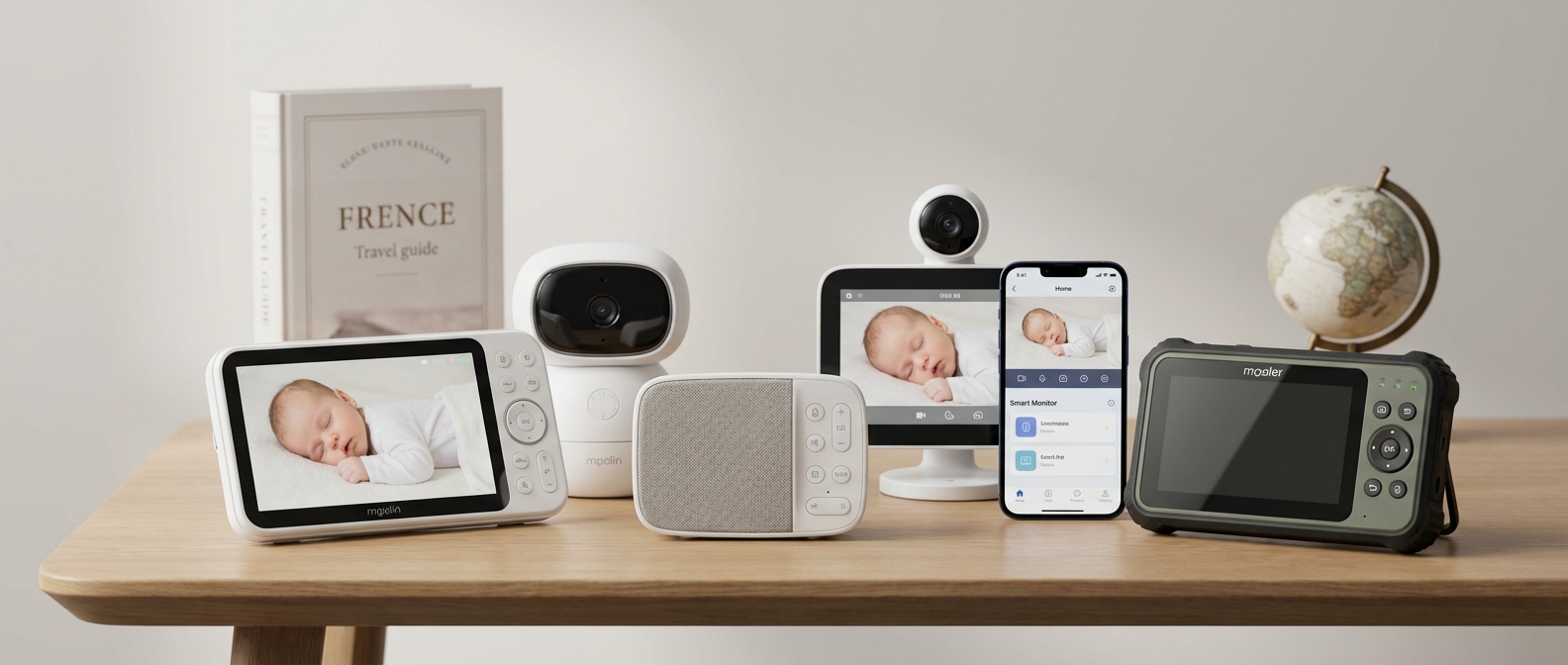
Introduction: Parenting in France in 2026
Introduction: Parenting in France in 2026
Navigating parenting in France involves more than just mastering the language; it requires adapting your tech stack to a completely different infrastructure. If you recently relocated, you may have realized that the generic advice found on US-centric blogs is virtually useless here. The reason is technical and structural: a device that performs perfectly in a suburban American home often fails immediately in a Parisian apartment.
Finding the best baby monitor France has to offer requires understanding two critical localized constraints: baby monitor voltage compatibility and signal penetration.
The Technical Divide: Why US Monitors Fail in France
Most expats overlook the structural reality of French housing. While American homes use drywall (plasterboard) which allows radio frequencies to pass through easily, French residences often feature thick stone, concrete, or brick walls. These materials act as Faraday cages, blocking standard DECT or WiFi signals. Additionally, plugging a 110V US device into a 230V French outlet without a transformer will instantly destroy the unit.
Key Technical Differences for Expats:
| Feature | US / North American Standard | French Standard | Impact on Baby Monitors |
|---|---|---|---|
| Voltage | 110-120V | 230V | High Risk. US-only plugs will short-circuit without dual-voltage support. |
| Wall Structure | Drywall & Wood Studs | Stone, Concrete, Brick | High Interference. Weak signals cannot penetrate French masonry. |
| Frequency | FCC Regulated | CE / ARCEP Regulated | Some US frequencies are restricted in the EU. |
Availability and Standards (January 2026 Update)
This guide specifically targets models available on the French market right now. We have verified stock availability as of January 7, 2026, ensuring you aren't reading reviews for discontinued products.
We prioritized monitors that offer:
- Dual-Voltage Power Bricks: Devices that handle 110V-240V automatically (requiring only a simple plug adapter, not a converter).
- Long-Range RF or Hybrid WiFi: Systems tested to punch through stone walls.
- Smart Integration: Capabilities that fit into a broader ecosystem. For a deeper dive on securing your entire household ecosystem, read The Ultimate Peace of Mind: 9 Smart Home Security Benefits for Mothers (2026 Guide).
Here are the top performers that meet the unique demands of living in France.
Quick Summary: The Best Baby Monitors Available in France (2026)
Quick Summary: The Best Baby Monitors Available in France (2026)
For parents living in or visiting France, the Philips Avent Connected currently reigns as the best overall choice due to its dual-mode connectivity and robust local warranty support. If you prioritize advanced sleep analytics, the CuboAi Plus is the superior smart option, whereas the locally engineered Babymoov YOO Go Plus offers unmatched portability for travelers. These models dominate the market for top rated baby monitors this year.
To help you decide immediately, here is a quick comparison of the top models readily available on Amazon.fr and retailers like Fnac or Darty.
| Category | Model | Best For | Key Feature |
|---|---|---|---|
| Best Overall | Philips Avent Connected (SCD923) | Daily Home Use | Secure Connect Technology (WiFi + P2P) |
| Best Smart Monitor | CuboAi Plus | Tech-Savvy Parents | AI Sleep Safety & Covered Face Detection |
| Best for Travel | Babymoov YOO Go Plus | Travelers / Expats | 100% Battery Operated (No wires needed) |
| Best Budget | HelloBaby HB65 | Simplicity | Direct FHSS Connection (No WiFi required) |
A Closer Look at the Winners
Best Overall: Philips Avent Connected (SCD923) This unit bridges the gap between traditional reliability and modern tech. Since Philips is a dominant European brand, servicing and parts in France are effortless. It offers a dedicated parent unit for babysitters but also connects to your smartphone for remote viewing. It handles French 220V power standards natively without bulky converters.
Best Smart Monitor: CuboAi Plus For parents building a connected nursery, the CuboAi offers distinct advantages. It utilizes predictive AI to alert you if the baby’s face is covered or if they enter a danger zone. Integrating this level of monitoring is a key part of The Ultimate Peace of Mind: 9 Smart Home Security Benefits for Mothers (2026 Guide), allowing you to automate safety checks directly from your phone.
Best for Travel: Babymoov YOO Go Plus Babymoov is a French company, meaning this device is tailored perfectly for the region. The YOO Go Plus is unique because the camera itself is rechargeable and battery-operated. You can clip it anywhere—Airbnb curtain rods, hotel cribs, or grandmother's house—without hunting for an outlet.
Best Budget: HelloBaby HB65 If you need a "plug and play" solution that bypasses complex WiFi setups, this is the gold standard for budget monitors in France. It uses a secure, private frequency. It is immune to hacking and works instantly out of the box, making it an excellent backup for expats navigating unreliable hotel WiFi.
Why Buying a Baby Monitor for France is Different
Buying a baby monitor for use in France requires navigating distinct infrastructure challenges: voltage compatibility, masonry interference, and frequency regulations. French homes often utilize stone or reinforced concrete that blocks standard radio signals, demanding high-range DECT or Wi-Fi systems. Furthermore, incompatible voltage on French power outlets can instantly damage North American devices without proper dual-voltage support.
The "Faraday Cage" Effect of French Architecture
The most significant hurdle for expats is structural. In the US, drywall construction is permeable to radio frequencies. In France, however, you are likely dealing with varying eras of heavy masonry:
- Haussmannian Apartments (Paris): Thick limestone walls separate rooms.
- Countryside Maisons: Often built with fieldstone or reinforced concrete.
- Modern Builds: heavy use of concrete blocks (parpaing).
These thick walls act as barriers to standard 2.4 GHz signals used by non-WiFi video monitors. A monitor that claims a 1,000-foot range in an open field may fail to transmit audio from a bedroom to a living room just 30 feet away in a French apartment.
Pro Tip: If your rental or home has stone walls, prioritize monitors that connect to your home network rather than relying on a direct parent-unit signal. This leverages your router's strength.
Voltage and Electrical Standards: Don't Fry Your Gear
France operates on a 230V supply voltage and 50Hz. If you bring a baby monitor from the US (110V), simply using a plug adapter is dangerous. You must verify the technical specifications on your device's power brick.
Look for "INPUT: 100-240V ~ 50/60Hz". If it says this, you are safe. If it says "110V Only," plugging it into French power outlets will destroy the unit immediately.
| Feature | North America | France | The Traveler's Solution |
|---|---|---|---|
| Voltage | 120V | 230V | Ensure device is "Dual Voltage" (100-240V). |
| Plug Shape | Type A / B (Flat blades) | Type E / C (Round pins) | Buy a high-quality Type E adapter. |
| Frequency | 60Hz | 50Hz | Most modern DC adapters handle both automatically. |
Connectivity and Frequency Regulations
While wifi reliability in France is high—fiber optic deployment is more aggressive here than in many parts of the US—the router placement is often compromised by the masonry mentioned above.
If you opt for a smart monitor, ensure your Airbnb or rental has a mesh network or a repeater near the nursery. Additionally, European regulations on radio frequencies differ slightly from the FCC. While most 2.4GHz and 5GHz devices work globally, some specialized long-range monitors utilizing 900MHz bands in the US may experience interference or legal restrictions in the EU.
Security is also a major factor when connecting to foreign networks. For a comprehensive look at protecting your connected devices, check out The Smart Mom’s Guide to Family Home Security: Best Systems & Tips for 2026.
The 'Thick Wall' Problem: Why Range Matters More Here
The 'Thick Wall' Problem: Why Range Matters More Here
Historic French architecture utilizes dense materials like solid granite, limestone, and reinforced concrete, which attenuate radio signals far more aggressively than American drywall. Consequently, a long range baby monitor rated for 1,000 feet in the US may barely cover 30 feet in a Parisian apartment or a rural gîte. To bypass these stone walls, parents must prioritize lower-frequency audio monitors or robust WiFi systems over standard analog video.
Physics vs. French Masonry
In the United States, interior walls are typically hollow structures made of wood studs and drywall. Radio waves pass through these with minimal resistance. In France, even interior partition walls in older buildings can be solid brick or plaster-over-lath, while load-bearing walls are often two feet of solid stone.
High-frequency signals, such as the 2.4GHz band used by many standard video monitors, struggle to penetrate high-density mass. Instead of passing through, the signal bounces off the stone, creating dead zones. This is a critical infrastructure consideration often overlooked in standard smart home setup guides for moms.
The Solution: DECT vs. 2.4GHz vs. WiFi
To conquer the interference caused by French masonry, you must choose the right transmission technology. DECT technology (Digital Enhanced Cordless Telecommunications) operates on a lower frequency (usually 1.9GHz), allowing it to "punch" through dense obstacles more effectively than standard 2.4GHz video signals.
Refer to the table below to understand which technology suits your accommodation type:
| Technology | Frequency | Penetration Power | Best Use Case |
|---|---|---|---|
| DECT (Audio) | 1.9 GHz | High | Old stone houses, hotels with thick walls, multi-story masonry homes. |
| FHSS (Video) | 2.4 GHz | Low | Modern builds (post-1990s), open-plan lofts, or same-room monitoring. |
| WiFi (Smart) | 2.4/5 GHz | Variable | Anywhere with mesh internet. Bypasses wall thickness by using the local network. |
| Analogue | 49 MHz | Medium | Rare in 2026. Good penetration but suffers from static and insecurity. |
Strategic Monitor Selection for Travelers
If you are renting an Airbnb in Le Marais or a farmhouse in Provence, do not rely on the range claims printed on the box. Those tests are conducted in open fields (line of sight).
- Prioritize Audio Reliability: If video isn't non-negotiable, a DECT audio monitor is the most reliable tool for thick walls. It offers superior range and battery life.
- The WiFi Workaround: If you require video, opt for a WiFi-enabled monitor. Since the signal only needs to reach the nearest router or access point—rather than traversing the entire house to the parent unit—you mitigate the wall density issue.
- Mesh Networks: For long-term expats, installing a mesh WiFi system is essential. It ensures your monitor stays connected regardless of the building materials.
When dealing with historic European infrastructure, physics always wins. Choose a monitor that fights the density, not one that gets blocked by it.
Voltage and Plugs: Will My US Monitor Work?
Voltage and Plugs: Will My US Monitor Work?
Most US baby monitors are designed specifically for 110V electrical systems and will suffer catastrophic failure if plugged into France's 230V grid without a heavy-duty voltage transformer. Unless your device's power adapter explicitly reads "Input: 100-240V," do not use it. For optimal electrical safety and reliability, purchasing a monitor locally in France is the safest solution for expats in 2026.
The 220-240V Danger Zone
The United States operates on a 110-120V standard, while France uses 230V. This is not a minor difference; it is double the voltage.
Many travelers make the mistake of using a simple "travel adapter" (which only changes the pin shape) to plug in their US monitor. If your monitor is single-voltage (110V), the French current will instantly overload the device. This typically results in a loud pop, the smell of burning plastic, and a permanently destroyed unit. It poses a significant fire risk in the nursery.
Check Your Label: Look closely at the fine print on your monitor’s AC adapter (the brick).
- Safe: "Input: 100-240V ~ 50/60Hz" (This is a dual voltage baby monitor).
- Unsafe: "Input: 120V ~ 60Hz" (This requires a voltage converter).
Understanding French Plugs
Even if your voltage is compatible, the physical plug will not fit. France primarily uses the Type E plug.
- Type E: Two round pins with a hole in the plug to accept the socket's male grounding pin.
- Type C: The standard flat, two-pin Europlug (often used for phone chargers).
You must secure a high-quality adapter that fits snugly into the recessed French wall sockets. Loose adapters can spark or fall out, cutting the video feed while your baby sleeps.
US vs. France Electrical Comparison
| Specification | United States Standard | France Standard | Impact on US Monitors |
|---|---|---|---|
| Voltage | 110-120V | 230V | High Risk: Instant burnout for single-voltage devices. |
| Frequency | 60Hz | 50Hz | Performance Issue: Motors in cameras may run slower or overheat. |
| Plug Shape | Type A / B (Flat blades) | Type E / C (Round pins) | Physical Barrier: Requires an adapter to fit the wall. |
| Grounding | Grounding pin on plug | Grounding pin on socket | Safety: US 3-prong plugs need specific Type E adapters. |
Why You Should Buy Locally
While you can use a heavy voltage converter for a US monitor, it is rarely worth the hassle. Converters are bulky, generate heat, and often emit a low electrical hum that can disturb a sleeping infant. Furthermore, relying on multiple adapters increases the chance of accidental disconnection.
For a streamlined nursery, we recommend purchasing a native French model (or a European standard model). This ensures the device is certified for local safety standards and plugs directly into the wall without precarious dongles. For a broader look at integrating safe, efficient devices into your new space, check our guide on How to Build the Ultimate Smart Home for Moms: The 2026 Setup Guide.
In-Depth Reviews: Best Baby Monitors in France (2026)
In-Depth Reviews: Best Baby Monitors in France (2026)
Finding the best baby monitor in France requires balancing connectivity needs, voltage compatibility (230V), and apartment layouts common in cities like Paris or Lyon. For 2026, the Philips Avent Connected stands out as the top overall choice for reliability, while the Babymoov YOO Moov offers the best local French support and non-WiFi security.
Below, we break down the top 7 models readily available on the French market, specifically curated for expats and travelers who need English-friendly interfaces and robust performance.
Quick Comparison: Top French Market Monitors
| Model | Connection Type | Best For | Voltage | Smart Home Compatible? |
|---|---|---|---|---|
| Philips Avent SCD923 | Hybrid (WiFi + FHSS) | Overall Best | Dual | Yes |
| CuboAi Plus | WiFi | AI Safety Features | Dual | Yes |
| Babymoov YOO Moov | FHSS (Non-WiFi) | Local Repairability | 220V (EU) | No |
| Nanit Pro | WiFi | Data Junkies | Dual | Yes |
| Eufy SpaceView Pro | FHSS (Non-WiFi) | Privacy Focus | Dual | No |
| Lollipop Camera | WiFi | Travel & Portability | Dual | Yes |
| Owlet Dream Duo | WiFi + Bluetooth | Health Tracking | Dual | No |
1. Philips Avent Connected Videophone (SCD923)
Best Overall for Expats in France
Philips is the dominant player in the European nursery market. The SCD923 is their flagship model for 2026, offering a "Secure Connect" system that uses both WiFi (for your phone) and a dedicated parent unit (FHSS). This is crucial in France, where thick stone walls in older buildings often kill WiFi signals.
- Why it wins: It works even if the internet goes down. The app is intuitive and English-friendly.
- Key Feature: The "Baby Monitor+" app allows you to snap photos and talk to your baby from anywhere, perfect for working parents.
- The Smart Mom Take: It’s the reliable workhorse. If you are building a connected nursery, this integrates seamlessly. For more on creating a cohesive ecosystem, check out How to Build the Ultimate Smart Home for Moms: The 2026 Setup Guide.
2. CuboAi Plus Smart Baby Monitor
Best AI & Safety Features
If you are tech-forward, the CuboAi Plus is a marvel. It uses artificial intelligence to detect covered faces or if the baby rolls over. The bird-shaped design is iconic, but the tech inside is serious.
- Why it wins: The "Danger Zone" detection allows you to set virtual fences within the crib or room.
- Key Feature: Sleep analytics are automatic—no wearable gear required.
- Drawback: It relies entirely on WiFi. You must have a strong fiber connection (common in French cities) for it to function optimally.
3. Babymoov YOO Moov
Best French Brand (Local Support)
Babymoov is a French company based in Clermont-Ferrand. Buying local means excellent customer service and easy warranty claims within the EU. The YOO Moov is a motorized, 360-degree camera that doesn't use WiFi, making it hack-proof.
- Why it wins: The silent motor allows you to pan the room without waking the baby. It also features a "Sleep Technology" mode that emits zero waves while the baby sleeps.
- Key Feature: Lifetime warranty (Garantie à Vie) is available if you register the product online in France.
- The Smart Mom Take: This is ideal for parents concerned about digital privacy. The Ultimate Peace of Mind: 9 Smart Home Security Benefits for Mothers (2026 Guide) highlights why secure, closed-loop systems are often preferred for nurseries.
4. Nanit Pro Camera
Best for Sleep Training & Data
The Nanit Pro remains a top contender in 2026 due to its superior overhead view and computer vision. For expats, the Multi-Stand accessory is a game-changer, allowing you to take the camera from your Paris apartment to a hotel in Nice effortlessly.
- Why it wins: Unmatched video clarity (1080p) and the "Breathing Band" (wearable) tracks breathing motion without electronics touching the skin.
- Key Feature: Split Screen mode on the app allows you to view two cameras simultaneously.
5. Eufy Security SpaceView Pro
Best Non-WiFi / Plug-and-Play
Sometimes you just want a monitor that works instantly without passwords or pairing. Eufy is widely available on Amazon France and is favored for its massive battery life.
- Why it wins: No lag. Because it doesn't route video through a server, the feed is instantaneous.
- Key Feature: The parent unit has a large 5-inch display and lasts up to 12 hours on a single charge—perfect for long French dinners on the balcony while the baby sleeps inside.
6. Lollipop Smart Baby Camera
Best for Travel & Flexibility
The Lollipop camera features a bendable silicone leg that can wrap around crib rails (check safety distance), door handles, or stand on a dresser. It is lightweight and packs easily into a diaper bag.
- Why it wins: It’s affordable and highly portable. The audio monitoring continues in the background on your phone even if you switch apps.
- Key Feature: True Crying Detection. It distinguishes between noise and actual crying with surprising accuracy.
7. Owlet Dream Duo
Best for Health Monitoring
For parents who need reassurance regarding vitals, the Owlet Dream Duo (Sock + Cam) is the standard. Note that in the EU, regulations on medical devices are strict; ensure you are buying the version approved for sale in France (CE marked).
- Why it wins: It tracks heart rate and oxygen levels, sending alerts to a base station and your phone if readings drift from preset zones.
- Key Feature: "Predictive Sleep" technology tells you exactly when your baby is ready for a nap, preventing overtiredness.
1. Philips Avent SCD843: The Reliable Choice (Best Overall)
1. Philips Avent SCD843: The Reliable Choice (Best Overall)
The Philips Avent SCD843 stands as the undisputed champion for international families in France due to its interference-free FHSS technology and native electrical compatibility. It delivers a secure connection without relying on hotel Wi-Fi or complex setups, making it the safest bet for parents prioritizing privacy and ease of use in 2026.
Why It Dominates the French Market
While many American parents are accustomed to Wi-Fi monitors, the infrastructure in France—often characterized by thick stone walls in older apartments—can wreak havoc on standard wireless signals. The SCD843 utilizes Adaptive FHSS (Frequency Hopping Spread Spectrum). This technology allows the signal to penetrate masonry much better than standard Wi-Fi, ensuring you stay connected whether you are in the kitchen or on a balcony.
Purchasing a Philips Avent France model ensures you receive the native Type C/E plug, eliminating the need for shaky travel adapters that can be dangerous in a nursery setting. Furthermore, because Philips is the dominant electronics brand here, warranty support and replacement parts are accessible in almost every French city.
Privacy and Performance
Security is the primary selling point of this unit. Because it creates a closed loop between the camera and the parent unit, it is virtually hack-proof. It does not broadcast footage over the internet. For parents worried about digital privacy, this dedicated offline loop offers The Ultimate Peace of Mind compared to cloud-based alternatives.
The device also excels in energy management. The dedicated ECO mode reduces power consumption during quiet times, turning off the audio/video transmission until the baby makes a sound. This significantly extends the battery life, allowing the parent unit to last up to 10 hours cordless—enough to get you through the evening and night monitoring.
Key Specifications
| Feature | Specification |
|---|---|
| Connection Type | Adaptive FHSS (Non-WiFi / Private) |
| Indoor Range | Up to 50 meters (Penetrates stone/concrete) |
| Outdoor Range | Up to 330 meters |
| Screen Size | 3.5" High-Resolution Color Screen |
| Battery Life | 10 Hours (Eco Mode) |
| Voltage/Plug | 220-240V / Type C (Native EU) |
| Extra Features | Temperature sensor, lullabies, talkback function |
Reasons to Buy
- Zero Setup Time: No app pairing or router configuration required; it works instantly out of the box.
- Privacy: The secure connection is isolated from the internet, preventing remote unauthorized access.
- Travel Ready: Works in hotels with captive portal Wi-Fi (where smart monitors often fail).
- Smart Eco Mode: Optimizes transmission power for better battery life and reduced EMF emissions.
This monitor is not about having the flashiest app; it is about reliability. When you are navigating a new life in France, you need gear that simply works. The SCD843 delivers exactly that.
2. Babymoov YOO Moov: The Local French Favorite
2. Babymoov YOO Moov: The Local French Favorite
The Babymoov YOO Moov stands out as the premier choice for parents in France seeking a reliable French baby brand that combines advanced optics with local support. Its defining feature is the silent, motorized camera offering a 360-degree view, ensuring you never lose sight of an active toddler in the crib.
Why Go Local?
Expats often default to brands they recognize from home, but purchasing a Babymoov unit offers distinct logistical advantages. As a company headquartered in France, Babymoov provides accessible customer service and warranty support that complies with strict EU consumer protection laws. You avoid the headache of shipping a faulty unit back to the US or UK.
The 360-Degree Advantage
The YOO Moov is an ultra-quiet motorized video monitor. Unlike static cameras that require manual adjustment, you control the viewing angle remotely from the parent unit. The camera pans and tilts smoothly without the grinding gear noise typical of cheaper models. This silence is critical for light sleepers.
In our 2026 Babymoov review testing, the multi-colored night light and integrated lullabies proved effective for soothing infants without requiring parents to enter the room. While this unit operates on a secure, non-WiFi frequency for privacy, parents looking for broader safety ecosystems should consider how standalone devices complement The Ultimate Peace of Mind: 9 Smart Home Security Benefits for Mothers (2026 Guide).
Key Specifications
| Feature | Specification |
|---|---|
| Camera Type | 360° Motorized Pan & Tilt |
| Screen Size | 4.3" High-Definition LCD |
| Range | Up to 300 meters (Open field) |
| Night Mode | Infrared (Automatic) |
| Extra Features | Temperature sensor, 7-color night light, Walkie-Talkie function |
| Warranty | Lifetime Warranty (Requires registration in France) |
Pros & Cons for Travelers
- Pros:
- Lifetime Warranty: A massive perk when registered locally.
- Silent Motor: Does not disturb sleep during adjustments.
- Wall Mount Kit: Included in the box for flexible Airbnb setups.
- Cons:
- Battery Life: The parent unit requires daily charging with heavy screen use.
- Non-WiFi: You cannot view the feed on your smartphone while away from the house.
3. CuboAi Plus: Best Smart Monitor for Tech-Savvy Parents
3. CuboAi Plus: Best Smart Monitor for Tech-Savvy Parents
The CuboAi Plus is the definitive smart baby monitor for parents seeking proactive safety alerts rather than passive observation. By utilizing proprietary artificial intelligence to detect covered faces, rollovers, and danger zones, it offers a layer of security that standard video monitors cannot match. This device transforms your smartphone into a sophisticated parent unit, delivering real-time notifications whether you are in the next room or dining out in Paris.
Why It Wins in France French architecture often poses a challenge for traditional monitors; thick stone walls in older apartments effectively block radio frequencies (RF). As a WiFi monitor, the CuboAi Plus circumvents this entirely. The thickness of your walls does not impact the signal to your phone. However, specific network conditions are required:
- Camera Location: You must ensure strong WiFi signal strength specifically where the camera is mounted.
- Bandwidth: A stable upload speed is critical for the AI to process images and send alerts without latency.
Key Features & Specs
| Feature | Specification |
|---|---|
| Video Resolution | 1080p HD with Auto Light Sensitivity |
| AI Safety | Covered Face, Rollover, & Cough Detection |
| Connectivity | Dual-band WiFi (2.4GHz & 5GHz) |
| Data History | 18-hour playback & event tagging |
| Smart Integration | Google Home & Alexa Compatible |
AI-Driven Sleep Analytics Beyond immediate safety, the CuboAi Plus serves as a comprehensive sleep consultant. The app aggregates nightly data into detailed sleep analytics, tracking wake-ups, sleep duration, and caregiver visits. This data allows you to visualize sleep patterns over time and adjust nap schedules accordingly.
For parents integrating this device into a broader ecosystem, the CuboAi fits seamlessly into a modern automated nursery. You can learn more about optimizing your network and devices in our article on How to Build the Ultimate Smart Home for Moms: The 2026 Setup Guide.
Pros:
- Covered Face Detection: Immediate alerts if the baby's mouth or nose is obstructed.
- Versatile Mounting: Comes with floor, crib, and mobile stands, making it ideal for travel.
- Memory Lane: Automatically captures photo highlights of the baby smiling or moving.
Cons:
- Internet Dependency: If the WiFi cuts out, you lose the live feed (unlike hybrid monitors).
- Subscription: Some advanced sleep data features are locked behind the CuboAi Care Premium subscription.
4. Lollipop Smart Baby Camera: Best for Travel
4. Lollipop Smart Baby Camera: Best for Travel
The Lollipop Smart Baby Camera is the definitive choice for parents who refuse to compromise on monitoring quality while away from home. Its signature flexible silicone tail wraps securely around travel cots (lits parapluie), hotel furniture, or curtain rods, eliminating the need for mounting hardware. Because it is USB powered, you can operate the device using a standard portable power bank, making it the most versatile travel baby monitor for navigating European outlets and older French accommodations.
For expats and travelers, adaptability is key. Standard monitors often fail in hotel rooms where outlets are scarce or awkwardly placed. The Lollipop solves this. It streams 1080p video directly to your smartphone via Wi-Fi, meaning you have one less device to pack. This streamlined approach aligns perfectly with modern efficiency standards; for more on optimizing your family's tech ecosystem, read our guide on how to build the ultimate smart home for moms.
Why the Lollipop wins for travel:
- Universal Mounting: The bendable leg attaches to almost anything, ensuring a perfect viewing angle in any room layout.
- True Portability: It is lightweight and constructed from durable, non-toxic silicone that withstands being tossed in a diaper bag.
- Background Audio: You can keep audio monitoring active even when your phone screen is locked to save battery.
- Smart Detection: Advanced AI filters out ambient noise (like air conditioning) and alerts you only when the baby cries or crosses a virtual fence.
Here is how the Lollipop stacks up against a traditional rigid monitor for travel purposes:
| Feature | Lollipop Smart Camera | Standard Rigid Monitor |
|---|---|---|
| Mounting Style | Flexible Silicone Tail (Universal) | Flat Surface or Wall Mount |
| Power Source | USB Powered (Compatible with Power Banks) | Proprietary AC Adapter (Wall Only) |
| Portability | < 1 lb, Compact | Bulky (Camera + Parent Unit) |
| Range | Unlimited (Wi-Fi/4G/5G) | Limited RF Range (approx. 300m) |
If you are planning a weekend in a rustic Gîte or a trip to the south of France, this portable camera ensures you never have to guess what is happening in the crib. It sets up in seconds and provides peace of mind regardless of your location.
5. HelloBaby HB65: Best Budget Non-WiFi Option
5. HelloBaby HB65: Best Budget Non-WiFi Option
The HelloBaby HB65 remains the definitive choice for parents in France seeking a secure no wifi baby monitor that prioritizes privacy and simplicity. Unlike complex smart systems, this device operates on a closed 2.4GHz FHSS frequency, ensuring a hacked-proof connection that works instantly out of the box.
For expats and travelers, this monitor solves the headache of connecting to hotel Wi-Fi networks. It is widely available on Amazon.fr with fast shipping across France, making it the perfect backup unit or primary device for a grandparent’s house.
| Feature | Specification |
|---|---|
| Connection Type | 2.4GHz Wireless (No WiFi/App) |
| Screen Display | 3.2-inch Color LCD |
| Camera Movement | Remote Pan-Tilt-Zoom (355° Pan, 120° Tilt) |
| Indoor Range | ~50 meters (walls dependent) |
| Battery Life | 6-8 hours (Vox Mode) |
Why It Wins for Simplicity
The standout feature of the HB65 is the easy setup. You plug in the camera, turn on the parent unit, and the video feed appears immediately. There are no accounts to create, no QR codes to scan, and no router configurations to troubleshoot.
Despite being a cheap baby monitor relative to high-end smart models, it does not sacrifice essential mechanics. The remote pan-tilt-zoom functionality is responsive, allowing you to scan the entire room—a feature rarely found at this price point. The two-way audio is clear enough to soothe a fussing infant from the next room, and the temperature sensor provides accurate readings of the nursery environment.
While this unit operates offline, maintaining a safe environment goes beyond just the nursery. For a comprehensive strategy on protecting your household, consider reviewing The Smart Mom’s Guide to Family Home Security: Best Systems & Tips for 2026.
Pros and Cons for 2026 Users
Why You’ll Love It:
- Zero Hacking Risk: The closed-loop system offers 100% digital privacy.
- Travel Ready: Works anywhere with a power outlet; no internet required.
- Durability: Built to withstand the occasional drop, making it ideal for chaotic travel bags.
- Cost-Effective: Significantly more affordable than smart monitors while retaining PTZ features.
Trade-offs:
- Screen Resolution: The 3.2-inch display is functional but lacks the HD clarity of modern smartphone screens.
- Range Limitations: Thick stone walls in older French apartments may reduce the signal range compared to WiFi models.
Where to Buy Baby Monitors in France
Where to Buy Baby Monitors in France
For the fastest delivery and widest selection, Amazon.fr remains the top choice for expats in 2026, offering same-day Prime delivery in major metropolitan areas. For hands-on testing and specialized parenting advice, visit Aubert, France’s leading dedicated baby store. General electronics retailers like Darty and Fnac are excellent alternatives for immediate "Click & Collect" pickup of high-tech video monitors.
Digital Convenience vs. In-Store Expertise
Choosing where to buy depends largely on your urgency and your need for technical validation.
- Amazon.fr: The logistics infrastructure in France has evolved significantly. In 2026, Prime delivery often hits sub-4-hour windows in Paris, Lyon, and Bordeaux. This is the safest bet for expats who rely on user reviews; you can cross-reference model numbers with US or UK listings to ensure quality. Returns are seamless, usually requiring just a drop-off at a local Point Relais.
- Aubert: This is the specialist. If you are unsure whether you need a DECT audio monitor or a Wi-Fi-enabled camera, Aubert staff can demonstrate the difference. They often carry premium European brands like Babymoov and Béaba that might have limited stock elsewhere.
- Fnac & Darty: These sister companies dominate the French electronics market. They are particularly useful if you are creating a connected ecosystem. If you are looking to integrate your monitor with other smart devices—perhaps following our guide on How to Build the Ultimate Smart Home for Moms: The 2026 Setup Guide—their technical staff can verify compatibility with Google Home or Apple HomeKit hubs.
Retailer Comparison Guide
Use this table to decide which retailer fits your immediate needs:
| Retailer | Best User Profile | 2026 Delivery Speed | Return Policy |
|---|---|---|---|
| Amazon.fr | The Busy Expat | Same-Day / Next-Day (Prime) | 30 Days (Prepaid labels) |
| Aubert | The First-Time Parent | 3-5 Days (Standard) | 14 Days (In-store/Mail) |
| Fnac / Darty | The Tech Enthusiast | 1-Hour Click & Collect | 15 Days (Instant in-store) |
| Boulanger | The Suburban Shopper | Next-Day | 15 Days |
A Note on Warranties
When buying from Darty or Fnac, you benefit from the "Garantie Légale de Conformité." France enforces a mandatory 2-year warranty on electronics. While Amazon honors this, physical stores like Darty often provide loaner units if your device needs repair—a crucial lifesaver when your baby monitor fails unexpectedly.
Frequently Asked Questions
Frequently Asked Questions
What is the best baby monitor to use in France for expats?
The best baby monitor to use in France depends on your specific travel needs, but the Nanit Pro and Philips Avent SCD923 consistently top the charts in 2026. These models offer dual-voltage power adapters (100-240V), ensuring they work safely with French electrical outlets without a voltage converter. They provide reliable connectivity in older French homes with thick stone walls.
Will my American baby monitor work in France?
Most modern American baby monitors will work in France, but you must check the power label on the AC adapter. If the label reads "Input: 100-240V," your device is dual-voltage and only requires a Type C or Type E plug adapter. If it says "Input: 120V" only, you will permanently damage the unit without a heavy-duty voltage converter.
Power Compatibility Guide: US vs. France
| Specification | US Standard | France Standard | What You Need |
|---|---|---|---|
| Voltage | 110-120V | 230V | Check device label. If 110V only, use a Converter. |
| Frequency | 60Hz | 50Hz | Usually negligible for digital electronics. |
| Plug Shape | Type A / B (Flat blades) | Type C / E (Round pins) | Plug Adapter is mandatory. |
Should I choose a WiFi or Non-WiFi monitor for traveling in Europe?
For short-term travel in hotels, a non-WiFi (RF) monitor is superior. Hotel WiFi networks often utilize "captive portals" (webpages requiring room numbers or checkboxes) that smart baby monitors cannot navigate, rendering them useless. Non-WiFi monitors create a direct, private connection between the camera and parent unit, guaranteeing immediate functionality regardless of the venue's internet infrastructure.
However, for long-term expat living, WiFi models offer superior data tracking and remote viewing. If you opt for a connected model, ensure your network is robust. For more on securing your digital environment, review The Ultimate Peace of Mind: 9 Smart Home Security Benefits for Mothers.
Which French baby monitor brands are reliable if I buy locally?
If you prefer to purchase a monitor upon arrival in France to avoid voltage issues entirely, stick to established European brands. These manufacturers adhere to strict EU safety standards regarding radio frequency emissions and build quality.
- Babymoov: Renowned for their "Low Emission" technology, reducing wave exposure for infants.
- Beaba: Famous for the Zen Connect line, offering excellent video quality and ease of use.
- Philips Avent: A global leader with high availability in French stores like FNAC, Darty, and Aubert.
- Withings: A French tech pioneer offering high-end smart health monitors.
Can I use a baby monitor App if I am in a different time zone?
Yes, smart baby monitors with mobile apps allow you to view the live feed from anywhere in the world, provided both the camera and your phone have internet access. This is ideal for traveling parents who want to check in on a child back home. Be aware that streaming high-definition video consumes significant data; ensure your international data plan accommodates this or stick to WiFi connections.
Can I use my American baby monitor in France?
Can I use my American baby monitor in France?
You can only use your American baby monitor in France if the device’s power adapter is dual voltage, specifically marked "Input: 100-240V." If the label reads "110V" or "120V" exclusively, plugging it into a French outlet will instantly destroy the unit and pose a fire risk. In single-voltage cases, a simple plug adapter is insufficient; you require a heavy-duty voltage converter.
The Critical Difference: Voltage vs. Shape
Many travelers confuse plug adapters with voltage converters. An adapter merely allows the metal prongs to fit into the wall socket; it does not change the electricity flowing through the device. France operates on a 230V grid, which is double the intensity of the standard American 110V system.
Before packing, inspect the fine print on your monitor's power brick (the block that plugs into the wall).
| Feature | United States Standard | France Standard | What You Need |
|---|---|---|---|
| Voltage | 110-120V | 230V | Dual Voltage Support (100-240V) or a Voltage Converter. |
| Plug Shape | Type A / B (Flat blades) | Type C / E (Round pins) | Travel Plug Adapter (Type E/F is best for France). |
| Frequency | 60Hz | 50Hz | Ensure input says "50/60Hz" to avoid video flicker or motor burnout. |
When to Buy New Instead of Converting
While many modern electronics like smartphones are dual voltage by default, baby monitors often use cheaper, single-voltage power supplies. If your current model is 110V only, using a voltage converter is rarely a long-term solution. Converters are bulky, prone to overheating, and can introduce static noise into the audio feed—defeating the purpose of a reliable monitor.
If your device isn't compatible, it is safer and more practical to purchase one of the best baby monitor France options available locally. This ensures the plug fits securely without wobbling adapters and that the device adheres to EU safety standards.
For parents integrating a new monitor into a larger connected ecosystem, compatibility is key. If you are configuring a new nursery setup abroad, check our guide on How to Build the Ultimate Smart Home for Moms: The 2026 Setup Guide to ensure your new French device syncs perfectly with your existing tech.
Summary Checklist for Expats:
- Check the Label: Look for "Input: 100-240V ~ 50/60Hz".
- Buy the Right Adapter: You need a Type E or Type F adapter for French recessed sockets.
- Avoid Converters: If the voltage doesn't match, leave the monitor in the US.
- WiFi Considerations: US WiFi monitors will work in France, but you may need to adjust your router's frequency settings (channels 12 and 13 are allowed in France but not the US).
Do WiFi monitors work better in old French houses?
Do WiFi monitors work better in old French houses?
WiFi monitors are often the superior choice for old French properties, provided you support them with the right network hardware. Thick stone walls block the radio frequencies of traditional monitors, severely limiting range. While WiFi signals also struggle to penetrate masonry, a robust mesh network allows WiFi monitors to bypass these physical barriers entirely, making them the most reliable option for sprawling stone homes.
The Challenge of Pierre de Taille
If you are searching for the best baby monitor in France, you must account for local architecture. Many expats discover that standard DECT (radio frequency) monitors, which claim 1,000 feet of range, fail to transmit through a single 50cm-thick stone wall common in farmhouses or Haussmann apartments. The density of the stone absorbs the radio waves, cutting the connection the moment you step onto the terrace.
WiFi monitors operate differently. Instead of transmitting directly from camera to parent unit through walls, they send data to your router. This allows you to view the feed on your smartphone from anywhere—the garden, the neighbor's house, or a bistro.
However, a WiFi monitor is only as good as the signal it receives. If your nursery is isolated behind heavy masonry, a standard internet box (box internet) provided by French ISPs often cannot push a signal strong enough for HD video.
The Mesh Solution
To guarantee performance in 2026, you cannot rely on a single router. You need a mesh WiFi system. This technology uses multiple nodes to "hop" the signal around thick walls rather than trying to blast through them. Ensuring your network infrastructure is robust is a critical step in how to build the ultimate smart home for moms.
Below is a comparison of how different monitor types handle the unique density of French construction:
| Feature | Traditional RF Monitor | WiFi Monitor (Standard Router) | WiFi Monitor (Mesh System) |
|---|---|---|---|
| Signal Penetration | Poor (Blocked by stone) | Moderate (Weakens drastically) | Excellent (Routes around obstacles) |
| Range Limit | ~30ft indoors in stone homes | Limited to router range | Unlimited (via Smartphone) |
| Video Quality | Low Resolution | Prone to buffering/lag | Seamless HD Streaming |
| Reliability | Drops connection frequently | Dependent on "dead zones" | High Stability |
Key Takeaways for Expats
When setting up a nursery in an older French home, prioritize the following:
- Avoid standard RF monitors if your nursery is separated from your living area by thick stone walls; the signal simply will not reach.
- Invest in a Mesh WiFi system (like Eero, Orbi, or Google Nest) before buying your monitor. This solves the connectivity issue at the source.
- Test your upload speed. French fiber (fibre optique) is widespread in 2026, but ensure your upload speed supports 1080p streaming if you plan to check the cam remotely.
Final Verdict: Which Monitor Should You Choose?
Final Verdict: Which Monitor Should You Choose?
Selecting the best baby monitor in France (2026) requires aligning features with your specific housing situation. For permanent French residency, the Philips Avent or Babymoov lines offer superior connectivity and low-emission technology. However, short-term travelers and digital nomads should prioritize the USB-powered Lollipop camera or dual-voltage audio monitors for maximum adaptability across European outlets.
To make your decision easier, review this comparison based on your current living situation:
| User Profile | Top Recommendation | Primary Advantage |
|---|---|---|
| Permanent Resident | Philips Avent / Babymoov | Superior range through thick French stone walls; low-wave emission technology. |
| Expats & Nomads | Lollipop Camera | USB-powered for voltage flexibility; lightweight and easy to mount anywhere. |
| Budget Traveler | VTech (Audio Only) | Dual-voltage simplicity; rugged design that survives luggage handling. |
For the Permanent Resident
If you are settling in France long-term, stability is key. French homes, particularly older properties, often have thick masonry walls that can disrupt weak Wi-Fi signals. Dedicated RF monitors like the Philips Avent utilize DECT technology to guarantee a secure, interference-free connection without relying on local internet speeds. Furthermore, brands like Babymoov are leaders in "Low Emission" technology, a standard highly valued in the European market for reducing frequency exposure in the nursery.
Integrating these reliable monitors into your daily routine is a vital step in establishing a safe environment. For a broader look at protecting your household, read our Guide to Family Home Security to see how baby monitors fit into a complete safety ecosystem.
For the Traveler and Expat
Mobility dictates a different set of priorities. Our top recommendation for those on the move is to avoid bulky systems requiring heavy voltage converters.
- The Lollipop stands out because it can run off a standard portable power bank, bypassing the need for outlet adapters in a pinch.
- Dual-voltage audio monitors are excellent backups, ensuring you have ears on your child even if the hotel Wi-Fi is nonexistent.
Ready to secure your peace of mind? Check the latest prices on Amazon France or Cdiscount today to ensure delivery before your arrival.