
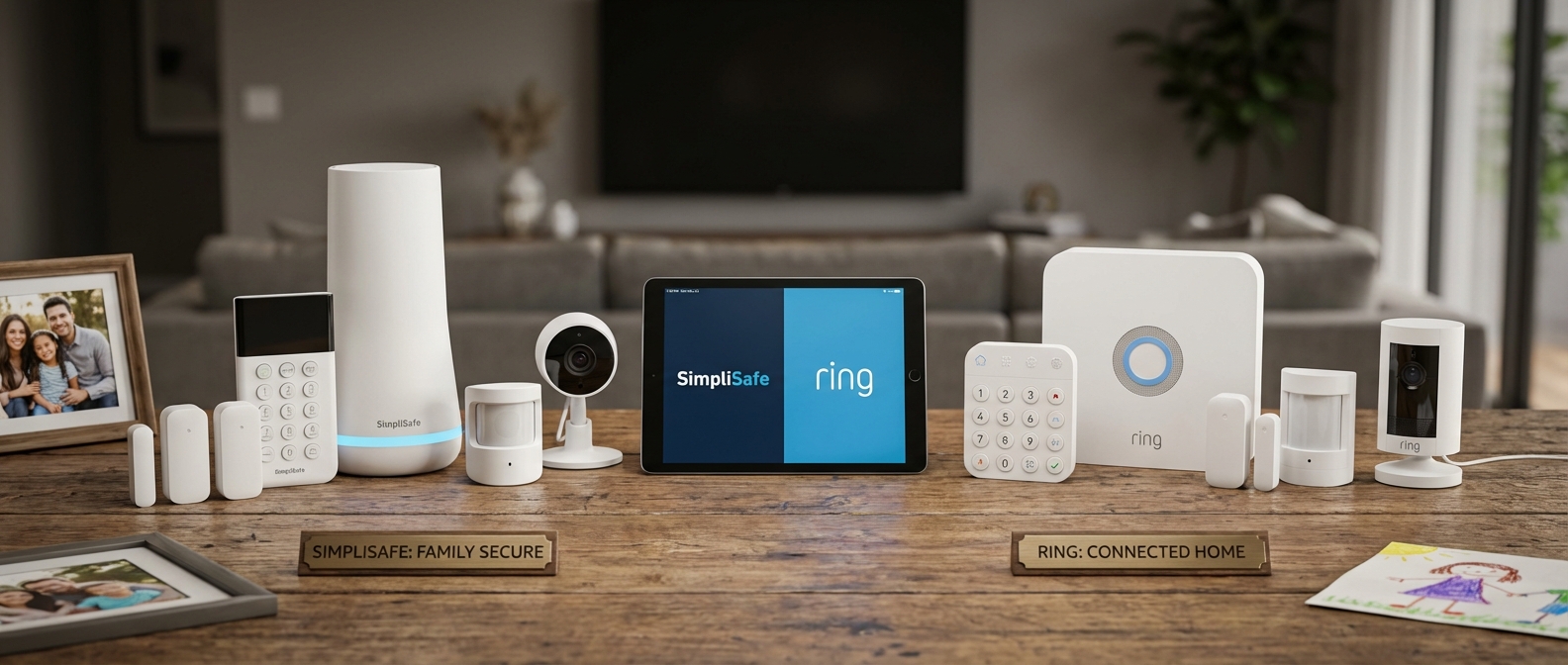
The 2026 Verdict: Which System Wins for Parents?
The 2026 Verdict: Which System Wins for Parents?
For most modern households, Ring is the overall winner in the SimpliSafe vs Ring 2026 battle due to its superior smart home automation and unmatched outdoor surveillance capabilities via the Ring Alarm Pro. However, SimpliSafe remains the undisputed champion for privacy-focused families and renters demanding a dedicated, fail-safe intrusion detection system without the complexity of the Amazon ecosystem.
While both companies have aggressively updated their hardware this year, their core philosophies have diverged further. Ring wants to manage your entire digital home; SimpliSafe just wants to secure it.
At a Glance: The Mom-Tested Comparison
Here is how the best home security for families stacks up in 2026.
| Feature | SimpliSafe (Gen 4) | Ring Alarm Pro |
|---|---|---|
| Primary Focus | Pure Security & Privacy | Smart Home & Connectivity |
| Installation | Peel-and-stick (Easiest) | DIY (Requires Eero Wi-Fi setup) |
| Privacy Rating | High (Visual privacy shutter) | Moderate (Amazon ecosystem) |
| Smart Home | Limited (Google/Alexa basic) | Excellent (Built-in Eero 6 hub) |
| Monitoring Cost | Higher ($30+/mo for Fast Protect) | Lower ($20/mo for Ring Protect Pro) |
| Best For | Renters, Privacy Advocates, Non-Techies | Homeowners, Alexa Users, Tech-Savvy Parents |
The Winner by Scenario
Choosing between SimpliSafe Gen 4 and the Ring Alarm Pro depends entirely on your parenting style and home infrastructure.
Best for Smart Home Integration: Ring
If your household runs on automation, Ring is the logical choice. The Ring Alarm Pro isn’t just a security hub; it is a Wi-Fi 6 router (Eero) that keeps your devices online even during power outages. This is critical for maintaining smart home routines for moms that rely on uninterrupted connectivity.
Because Ring is owned by Amazon, the integration with Alexa is flawless. You can pull up camera feeds on an Echo Show in the nursery or automate lights to flash when an alarm triggers. If you are already debating Alexa vs. Google Home for families, knowing that Ring anchors the Alexa ecosystem might make your decision easier.
Best for Privacy & Simplicity: SimpliSafe
SimpliSafe wins if you want a "set it and forget it" system. The new SimpliSafe Gen 4 sensors are smaller, faster, and boast significantly better range than previous iterations, yet they require zero technical know-how to install.
For parents concerned about Big Tech surveillance, SimpliSafe offers peace of mind. Their indoor cameras feature mechanical privacy shutters that audibly click shut—a physical guarantee that no one is watching. If you simply need a fortress for your home without configuring Wi-Fi mesh networks, this is your answer. For a deeper dive on why this separation matters, read our guide on family home security systems.
Best for Outdoor Security: Ring
SimpliSafe has improved its outdoor cameras, but Ring still dominates the perimeter. Their ecosystem of floodlights, path lights, and doorbell cameras creates a proactive "Ring of Security" around your property. For families with active kids playing in the yard, Ring's motion zones and person detection are superior, alerting you to danger before it reaches the front door.
Final Recommendation
Buy Ring Alarm Pro if:
- You want a single app to control security and Wi-Fi.
- You rely heavily on Alexa for daily tasks.
- You need robust outdoor video surveillance.
Buy SimpliSafe Gen 4 if:
- You prioritize data privacy above all else.
- You want a dedicated security system that operates independently of your smart home clutter.
- You are a renter who needs a portable, damage-free installation.
Installation & Setup: The 'Nap Time' Test
Installation & Setup: The 'Nap Time' Test
SimpliSafe passes the "nap time" test with flying colors, typically requiring just 30 to 45 minutes for a complete DIY installation. Its tool-free design is quiet and efficient. Ring, while still an easy setup security system, often demands drilling and complex app pairing, pushing the process over an hour and risking a noisy disruption to your child’s sleep.
SimpliSafe: The Silent Setup
SimpliSafe was engineered for speed. The entire system arrives pre-paired to your Base Station. You simply plug in the "tower," pull the battery tabs, and the system announces the device is ready.
The standout feature for parents is the reliance on peel and stick sensors. Using industrial-strength adhesive strips, you can mount entry sensors and motion detectors without touching a tool. This means zero drilling noise. You can secure the entire perimeter of your home while your toddler sleeps in the next room, completely undisturbed.
Ring Alarm: The Ecosystem Commitment
Ring is robust, but it requires more "hand-holding" during setup. While the basic sensors also offer adhesive options, the sensors are bulkier, and many parents prefer screwing them in for permanence—especially if you have curious older kids who might pull them down.
Furthermore, Ring’s setup process is heavy on software. Each device must be scanned via QR code and often triggers an immediate firmware update. Watching a progress bar for 10 minutes per device destroys your time window. If you are installing Ring cameras alongside the alarm, you will need a drill, making this impossible to complete silently during a nap.
Comparison: Can You Beat the Clock?
| Feature | SimpliSafe | Ring Alarm (Gen 3) |
|---|---|---|
| Time to Install | 30–45 Minutes | 60–90 Minutes |
| Tool Requirement | None (Adhesive included) | Phillips Head / Drill (Recommended) |
| Noise Level | Silent (Peel & Stick) | Moderate to Loud (Drilling/Testing) |
| App Complexity | Low (Plug & Play) | High (Firmware Updates/Scanning) |
| Nap Time Verdict | Passes | Fails (Schedule for weekend) |
Vital Tool Checklist
Before you start, ensure you have the right equipment. Nothing kills a DIY installation faster than hunting for batteries.
- SimpliSafe:
- Smartphone (for initial Wi-Fi setup).
- Step stool (for high motion sensors).
- No tools required.
- Ring:
- Power drill & bits (for cameras or secure sensor mounting).
- Wi-Fi Password handy (Ring bridges can be finicky).
- Ladder.
If you are attempting to integrate these systems into a larger automation plan, such as triggering lights when an alarm sounds, the setup time will increase. For strategies on managing a complex ecosystem, consult The Smart Mom’s Guide to Family Home Security: Best Systems & Tips for 2026.
The Verdict: If you have exactly one hour of quiet time, choose SimpliSafe. If you want the deep integration of Ring, wait until you have a partner available to take the kids to the park.
SimpliSafe Setup: True Plug-and-Play?
SimpliSafe Setup: True Plug-and-Play?
Yes, SimpliSafe offers a genuine plug-and-play experience that remains the gold standard in 2026. You simply plug in the Base Station, pull the battery tabs on pre-paired sensors, and mount them using damage-free adhesive strips. For parents evaluating SimpliSafe vs Ring for family security, SimpliSafe wins on installation speed, requiring zero tools and typically finishing in under 30 minutes.
The Base Station: The "Talking" Brain
The installation process centers entirely around the Base Station. Unlike systems that require complex router configurations or wiring into a landline, the SimpliSafe Base Station requires only a standard power outlet.
Once plugged in, the light ring glows soft amber, and the device verbally guides you through the next steps. This voice-prompt feature is distinct; it reduces the need to constantly look at a manual or smartphone screen during the initial power-up. It immediately locates the wireless Keypad included in the box, establishing a secure connection without user intervention.
Sensor Pairing and Placement
SimpliSafe ships components with the batteries pre-installed, separated only by a plastic pull-tab. The system recognizes devices the moment you remove this tab.
- Grab the Keypad: The Keypad detects the new sensor instantly.
- Name the Device: You select a pre-set name (e.g., "Front Door," "Nursery Window") directly on the Keypad screen.
- Adhere: Peel the backing off the pre-applied 3M Command Strips and press the sensor against the wall or frame.
This "peel-and-stick" methodology is a massive advantage for families who cannot—or choose not to—drill holes in their walls. While Ring provides sticky tape, their instructions often lean heavily toward screwing devices in for permanence. SimpliSafe’s hardware is lighter, designed specifically to hold fast with just the adhesive.
Setup Snapshot: SimpliSafe vs. Traditional Install
The following table breaks down the installation requirements for a standard 3-bedroom home setup in 2026.
| Feature | SimpliSafe Setup | Traditional Wired Setup |
|---|---|---|
| Tools Required | None (Adhesive included) | Drill, Screwdriver, Wire Strippers |
| Connectivity | Cellular + Wi-Fi (Automatic) | Landline or Hardwired Ethernet |
| Sensor Mounting | 3M Command Strips | Drywall Anchors & Screws |
| Avg. Install Time | 25–30 Minutes | 4–6 Hours (or Professional Install) |
| Wall Damage | Zero | High (Requires patching if moved) |
Why "No-Drill" Matters for Parents
The lack of drilling is not just about laziness; it is about flexibility. As your children grow, your security needs shift. You might initially place a Motion Sensor in the hallway, but later decide to move it to the basement playroom. With SimpliSafe, you simply slide the sensor off the wall bracket and apply a new adhesive strip.
If you are currently planning how to organize your technology, check our guide on how to build the ultimate smart home for moms for more tips on flexible device placement.
The Base Station also features a "Test Mode." Before you officially activate monitoring, the system allows you to walk around the house, triggering sensors. The Base Station announces each triggered sensor by name ("Entry Sensor, Kitchen Window"), confirming range and function instantly. This tactile verification provides immediate peace of mind without triggering a false alarm dispatch.
Ring Setup: Integration Complexity
Ring Setup: Integration Complexity
Ring setup balances app-guided simplicity with moderate physical installation demands. While entry sensors utilize peel-and-stick adhesive, outdoor cameras often require drilling into siding or stucco. Crucially, the Ring Alarm Pro Base Station functions as an Eero Wi-Fi 6 router, requiring a hardwired ethernet connection to your modem to serve as the central nervous system of your home network.
The Base Station and Eero Backbone
Unlike traditional systems that merely sip Wi-Fi, the Ring Alarm Pro Base Station attempts to become your Wi-Fi. In 2026, Ring integrates an Eero Wi-Fi 6 router directly into the hub. You must connect the Base Station to your internet modem via an ethernet cable.
This setup offers distinct advantages for larger homes but introduces complexity:
- Network Replacement: You may need to replace your existing router or bridge it to avoid "double NAT" issues, which can block remote access to camera feeds.
- Signal Extension: Because the Base Station broadcasts your Wi-Fi, its placement is critical. You cannot hide it in a closet; it needs a central, open location to communicate effectively with cameras and sensors.
- Ecosystem Lock-in: This architecture aggressively pushes you toward the Amazon ecosystem. If you are deciding between Alexa vs. Google Home for Families (2026), know that Ring loses significant functionality without Alexa.
Outdoor Cameras: To Drill or Not to Drill?
When analyzing simplisafe vs ring for family security, physical installation is a major differentiator. Ring’s diverse camera lineup dictates the labor required.
- Battery & Solar Options: The Ring Stick Up Cam and Spotlight Cam Battery are versatile. You can mount them with a simple screw or place them on a flat surface. However, relying on batteries means regular recharging rituals—a friction point for busy parents.
- Hardwired Security: For continuous recording and brighter lighting, the Floodlight Cam Wired Pro is superior. This device requires working with high-voltage electrical wiring (110-240V). You will need to shut off the breaker, dismantle existing fixtures, and drill into your exterior junction box. If you lack electrical confidence, factor in the cost of a professional electrician.
Installation Requirements by Device Type
| Device Type | Installation Method | Power Source | DIY Difficulty |
|---|---|---|---|
| Ring Alarm Base Station | Ethernet to Modem | Wall Outlet + Battery Backup | Low (Plug & Play) |
| Contact Sensors | Adhesive Strip | Coin Cell Battery | Very Low |
| Stick Up Cam | Wall Mount (2 screws) | Quick-Release Battery / Solar | Low |
| Floodlight Cam Pro | Hardwired to Junction Box | Home Wiring (110-240V) | High (Electrical work) |
| Video Doorbell Wired | Existing Doorbell Wiring | Doorbell Transformer | Medium |
For a broader look at how to structure these devices within a busy household, review our guide on How to Build the Ultimate Smart Home for Moms. Proper planning prevents Wi-Fi dead zones that leave cameras offline when you need them most.
Equipment & Durability: Kid-Proofing Your Alarm
Equipment & Durability: Kid-Proofing Your Alarm
When evaluating hardware resilience against curious children, Ring takes the lead due to its robust, utilitarian construction that withstands rough handling. While SimpliSafe offers a more sophisticated aesthetic, its smaller sensors are easier for toddlers to dislodge. For families prioritizing durable door sensors and tamper resistance over interior design, Ring is the superior hardware choice in 2026.
Sensor Stability: The "Peel" Test
Hardware aesthetics matter, but in a home with children, durability is paramount. SimpliSafe has designed its equipment to disappear. The sensors are matte, slim, and shaped to blend into doorframes. While visually pleasing, the smaller surface area relies heavily on adhesive strips. A determined toddler can—and often will—peel these off the wall, triggering a tamper alert.
Ring, conversely, accepts its identity as security equipment. The contact sensors are bulkier and possess a larger footprint. This design choice allows for:
- Stronger Adhesion: More surface area for tape to grip the paint.
- Screw Mounting: The casing is designed to be screwed into the frame easily, making it nearly impossible for a child to remove without tools.
If you are looking for durable door sensors that survive the "terrible twos," Ring’s bulky build is an asset, not a flaw. For broader advice on child-proofing your tech, see our guide on 17 Best Smart Home Devices for Toddlers in 2026.
The Keypad and Panic Button Risk
The keypad design reveals a distinct difference in philosophy regarding emergency access.
- SimpliSafe: Features a dedicated, red panic button on the top of the keypad and the key fob. It is immediately accessible for emergencies. However, this accessibility is a liability with climbers. If a child reaches the keypad, a single press can dispatch police.
- Ring: Adopts a "friction" approach. Triggering the panic alarm usually requires holding specific buttons simultaneously for three seconds. This design effectively eliminates false alarms caused by curious fingers pressing glowing buttons.
Hardware Comparison: Family Suitability
| Feature | SimpliSafe (Gen 3) | Ring Alarm (2nd Gen) | Winner for Families |
|---|---|---|---|
| Sensor Build | Slim, lightweight, minimal grip area. | Chunky, heavy-duty plastic. | Ring |
| Mounting Security | Adhesive focused; screw mounting is possible but finicky. | Native screw mounting brackets included. | Ring |
| Panic Button | Single-press dedicated button (High false alarm risk). | Dual-press or hold required (Low false alarm risk). | Ring |
| Base Station | Elegant tower; soft glow light (attractive to kids). | Utilitarian box; easily hidden behind furniture. | SimpliSafe (Visuals) / Ring (Safety) |
| Keypad Durability | Smooth touch interface. | Rubberized tactile buttons. | Ring |
Base Station Vulnerability
SimpliSafe’s Base Station is beautiful—a sleek tower with a glowing LED ring. Unfortunately, this makes it a magnet for children. It looks like a toy. If a child unplugs it, the system switches to battery backup, but if they smash it during the entry delay, the signal might be interrupted (though SimpliSafe claims "SmashSafe" technology).
Ring’s Base Station is a flat, unassuming square. It does not look like a toy, and its form factor allows you to slide it onto a bookshelf or mount it high on a wall, completely out of reach. In the battle of form versus function, Ring wins the durability argument for active families.
Camera Quality & Monitoring: Keeping an Eye on the Chaos
Camera Quality & Monitoring: Keeping an Eye on the Chaos
Ring remains the superior choice for video fidelity and hardware variety in 2026, offering up to 4K resolution and color night vision, whereas SimpliSafe prioritizes privacy shutters and integration with their monitoring center over raw pixel count. If your priority is granular detail—like reading a license plate or checking a baby’s breathing motion—Ring is the clear winner, but SimpliSafe offers a "privacy-first" approach that many parents prefer for indoor spaces.
The Video Doorbell Comparison: Resolution and Field of View
For most families, the front door is the primary line of defense. In our video doorbell comparison, Ring continues to dominate. The Ring Battery Doorbell Pro (2026 model) offers head-to-toe video with 1536p resolution, allowing you to see packages left directly against the door. The image is crisp, vibrant, and handles backlit scenarios (like a bright sunset behind a visitor) with impressive HDR capabilities.
SimpliSafe’s Video Doorbell Pro is reliable but aging. It streams in 1080p and offers a wide field of view, but it lacks the vertical coverage necessary to see packages on the ground if your porch is shallow.
Indoor Camera Quality & Night Vision: The Nursery Test
When monitoring a nursery or playroom, indoor camera quality becomes a safety tool, not just security. Ring’s Indoor Cam (2nd Gen) features Color Night Vision, which provides surprising clarity in low light. This is vital when checking if a toddler is sleeping or just playing quietly.
SimpliSafe’s Smart Alarm Indoor Camera focuses on verification. The video is clear enough to identify an intruder, but the night vision relies on standard infrared (black and white). While effective for security, it lacks the nuance required for detailed nursery monitoring. However, SimpliSafe wins on privacy: the mechanical shutter audibly clicks shut when the system is disarmed, ensuring no one is watching your family when they shouldn't be.
For parents building a comprehensive safety net, integrating cameras that can accurately distinguish movement is a core component of Smart Home Safety for Kids.
Speed and Smarts: Time to Live and AI
A critical metric for parents is "Time to Live"—the seconds that elapse between tapping a notification and seeing a live feed.
- Ring: consistently loads the feed in 2-3 seconds on 5G or Wi-Fi 6E. Their "Pre-Roll" feature also shows you the 4-6 seconds before the motion event, giving you context.
- SimpliSafe: often takes 4-6 seconds to wake up the camera and establish a secure connection. This lag can be frustrating when you are trying to catch a delivery driver before they leave.
Regarding AI, Ring excels at differentiation. You can customize alerts to ignore the cat jumping on the sofa but trigger instantly for a person. SimpliSafe’s AI is strictly tuned for "people detection" to trigger alarms, which reduces false positives but offers less flexibility for pet owners. Both systems feature two-way audio, but Ring’s noise cancellation makes conversations significantly clearer.
At a Glance: Camera Specs Comparison
| Feature | SimpliSafe System (2026) | Ring Ecosystem (2026) |
|---|---|---|
| Max Resolution | 1080p HD | Up to 4K (Pro models) |
| Field of View | 140° (Horizontal) | Up to 160° (diagonal) |
| Night Vision | Standard IR (B&W) | Color Night Vision |
| App "Time to Live" | 4-6 Seconds | 2-3 Seconds |
| AI Detection | Person only (Security focused) | Person, Pet, Package, Vehicle |
| Privacy | Mechanical Privacy Shutter | Software Privacy Zones |
| Recording | Requires Subscription | Requires Subscription |
Indoor Cameras: The Nanny Cam Factor
Indoor Cameras: The Nanny Cam Factor
When you invite a camera into your living room, you are balancing protection against privacy. The deciding factor in the SimpliCam vs Ring Indoor Cam battle often comes down to a single hardware feature: the privacy shutter. SimpliSafe utilizes a mechanical, stainless steel shutter that physically blocks the lens when the system is disarmed, whereas Ring relies primarily on software toggles or a manual plastic cover you must slide yourself.
The Privacy Shutter: Why It Wins for Moms
For mothers, the interior camera is a source of significant anxiety. You want to monitor the babysitter or check on the kids, but you do not want to be recorded while breastfeeding on the sofa or walking around in a towel after a shower.
SimpliSafe solves this viscerally. When you disarm your system, the SimpliCam’s shutter snaps closed with an audible click.
- You hear it.
- You see it.
- You know it.
There is no "is this on?" panic. The lens is physically blocked. Ring, conversely, requires you to trust an LED light or remember to manually slide a plastic privacy cover over the lens. If you forget to slide it back when you leave, your security is compromised. For a busy mom, automating privacy is essential, not optional.
Specification Breakdown
While SimpliSafe wins on physical privacy, Ring puts up a fight with superior field of view and audio quality. Here is how the hardware stacks up in 2026:
| Feature | SimpliSafe SimpliCam | Ring Indoor Cam (2nd Gen) |
|---|---|---|
| Privacy Mechanism | Automatic Mechanical Shutter (Apps & Modes) | Manual Swivel Cover / Software Switch |
| Resolution | 1080p HD | 1080p HD (Enhanced Color Night Vision) |
| Field of View | 120° Diagonal | 143° Diagonal |
| Audio | 2-Way Audio (Standard) | 2-Way Audio (Noise Cancellation) |
| Smart Integration | Limited (Google/Alexa arming only) | Deep Alexa Integration |
The Verdict on Interior Surveillance
If your priority is a high-tech ecosystem where you can view feeds on an Echo Show, Ring is the superior piece of technology. It captures a wider angle of the room and integrates seamlessly with other Amazon devices.
However, for the specific "Nanny Cam" use case, SimpliSafe is the logical choice for families who occupy the home during the day. The mental load of worrying about digital voyeurism is removed entirely by the privacy shutter. Integrating these cameras is a key step in Smart Home Safety for Kids: The Ultimate Protection Guide (2026), but placement and privacy protocols must come first.
Choose Ring for the hallway or garage. Choose SimpliSafe for the living room where life actually happens.
Outdoor & Doorbell Cameras
Outdoor & Doorbell Cameras
When evaluating SimpliSafe vs. Ring for family security regarding exterior monitoring, Ring remains the undisputed leader for 2026 due to its superior hardware variety, advanced 3D motion detection, and rapid notification speeds. While SimpliSafe’s doorbell effectively visually verifies alarm triggers, it lacks the standalone surveillance capabilities and expansive field of view found in Ring’s ecosystem.
The Doorbell Showdown: Hardware Specs
Ring continues to flood the market with options ranging from budget battery models to high-end wired pro versions. SimpliSafe maintains a streamlined approach with a single primary offering designed to integrate tightly with their hub.
| Feature | Ring Battery Doorbell Pro (2026 Model) | SimpliSafe Video Doorbell Pro |
|---|---|---|
| Video Quality | 1536p HD+ (Head-to-Toe Video) | 1080p HD |
| Field of View | 150° Horizontal, 150° Vertical | 162° Wide Angle |
| Power Source | Removable Battery or Hardwired | Hardwired (8-24VAC) Only |
| Motion Detection | 3D Motion & Bird’s Eye View | Basic Heat Signature + Human Detection |
| Response Time | < 2 Seconds | 3-5 Seconds |
| Pre-Roll | Color Pre-Roll (4 seconds) | None |
Ring: The "Front Porch" Specialist
Ring dominates the front door because Amazon treats the doorbell as a primary security device, not just an accessory. The 2026 iteration of their Pro line features 3D Motion Detection, which uses radar technology to pinpoint exactly where movement begins.
For families, this reduces false alerts significantly. You won't get a notification for a car passing 30 feet away, but you will know immediately if a toddler steps off the porch. The "Head-to-Toe" aspect ratio is critical for The Ultimate Peace of Mind: 9 Smart Home Security Benefits for Mothers (2026 Guide), as it allows you to see packages left directly against the door—a blind spot for many standard wide-angle cameras.
- Pros: unparalleled variety, superior package detection, rich notification previews.
- Cons: requires a subscription for almost all useful features.
SimpliSafe: The Integrated Approach
SimpliSafe’s doorbell is competent, but it feels like a legacy product compared to Ring's rapid innovation. It shines only when paired with the full SimpliSafe ecosystem. Its superpower is visual verification. If your alarm triggers, the monitoring center can access the doorbell feed (with your permission) to verify a break-in, expediting police dispatch.
However, as a standalone device, it struggles. The lack of a battery-powered option in 2026 is a significant oversight for renters or older homes without existing doorbell wiring.
- Pros: seamless integration with the SimpliSafe keypad and lock, slim form factor.
- Cons: requires existing wiring, slower wake-up time, lower resolution.
Perimeter Defense: Outdoor Cameras
Beyond the doorbell, the battle for the backyard highlights a distinct philosophical difference between the two companies.
Ring offers a massive lineup, including the Floodlight Cam Wired Pro and the Spotlight Cam Plus. Their devices act as proactive deterrents. You can program the floodlights to trigger with motion, and the two-way audio is loud enough to startle an intruder.
SimpliSafe offers the Wireless Outdoor Security Camera. It is easy to install and relies on a rechargeable battery. While convenient, it lacks the "always-on" reliability of Ring’s wired options. If you want continuous recording or 24/7 monitoring of a play area, SimpliSafe falls short.
Verdict: Choose Ring if you want a robust video surveillance network that allows you to monitor kids and packages proactively. Choose SimpliSafe if you want a video doorbell solely to support a monitored alarm system.
Emergency Response & Monitoring Plans
Emergency Response & Monitoring Plans
Professional monitoring transforms a standard alarm system from a noisy deterrent into a verified lifeline. In 2026, the critical differentiator between these two giants is video verification, a process that allows monitoring agents to visually confirm a break-in, significantly increasing police dispatch speed and prioritizing your call over unverified alarms.
SimpliSafe: The Speed Specialist
SimpliSafe focuses heavily on reducing response times through its Fast Protect™ plan. When an alarm triggers, monitoring agents can access the video feed from your indoor cameras. If they see an intruder, they relay real-time physical descriptions to the police. This visual confirmation shifts the police priority from a "routine alarm" to a "crime in progress."
For families, the most underrated feature is SimpliSafe's secret alerts. Unlike a standard alarm that blares a siren, this setting allows specific sensors to send a silent notification to your phone.
- Medicine Cabinets: Know instantly if curious hands open the medicine drawer.
- Liquor Cabinets: Monitor restricted areas without alerting the whole house.
- Bedroom Windows: Get notified if a teenager tries to sneak out at night.
Ring: The Ecosystem Value
Ring’s monitoring strategy relies on volume and integration. The Ring Protect Pro plan covers all Ring devices at one address for a single flat rate. While Ring supports verified response in some jurisdictions, its strength lies in the SOS feature within the app, allowing you to request fire, medical, or police dispatch manually, even if the alarm hasn't triggered.
For a broader understanding of how these systems alleviate parental anxiety, read about The Ultimate Peace of Mind: 9 Smart Home Security Benefits for Mothers (2026 Guide).
Breakdown: Professional Monitoring Cost & Features
When analyzing the professional monitoring cost, Ring offers a lower monthly price point, but SimpliSafe provides more granular control over dispatch protocols.
| Feature | SimpliSafe (Fast Protect™) | Ring (Protect Pro) |
|---|---|---|
| Monthly Cost (2026) | ~$29.99/mo | ~$20.00/mo (or $200/yr) |
| Video Verification | Yes (Agents see video during alarm) | Limited (Depends on jurisdiction) |
| Police Dispatch Speed | Fastest (Due to verification priority) | Standard |
| Secret Alerts | Yes (Customizable by sensor) | No (Standard notifications only) |
| Cellular Backup | Included (Unmetered) | Included (3GB data cap for internet) |
| 24/7 Professional Monitoring | Yes | Yes |
| Contract Required | No (Month-to-month) | No (Month-to-month) |
If your priority is the absolute fastest emergency response, SimpliSafe’s video verification protocols justify the higher premium. However, if you already own multiple cameras and want to consolidate bills, Ring provides competent protection at a significantly lower aggregate cost.
Privacy & Data Security: A Major Concern in 2026
Privacy & Data Security: A Major Concern in 2026
For families prioritizing absolute privacy over smart home integration, SimpliSafe is the superior choice in 2026. While Ring has improved its encryption standards, its ownership by Amazon and the open nature of the 'Neighbors' app create inherent data vulnerabilities. SimpliSafe operates a closed ecosystem, treating you strictly as a paying customer to be protected, rather than a data point to be monetized.
The Amazon Factor vs. The Closed Garden
The fundamental difference lies in the business models. SimpliSafe makes money when you buy hardware and pay for professional monitoring. Their incentive is to keep that loop secure. Amazon, conversely, thrives on data.
Ring privacy concerns stem largely from its integration into the massive Amazon ecosystem. When you install a Ring device, you are effectively placing an Amazon data-gathering endpoint at your front door. The 'Neighbors' app, which allows users to share footage with local communities and law enforcement, transforms your personal security system into a node in a public surveillance network. While you can opt out of requests, the infrastructure is built on sharing.
SimpliSafe takes a "fortress" approach. They do not sell user data. They do not have a social media-style app for sharing clips with strangers. For parents worried about footage of their children ending up in a cloud database analyzed by AI, SimpliSafe’s isolationist policy offers superior peace of mind.
For a broader look at keeping your household secure, read our guide on Smart Home Safety for Kids: The Ultimate Protection Guide (2026).
Encryption and Camera Hacking Protection
In 2026, basic data encryption (AES-256 bit) is the industry standard for both companies during transmission and storage. However, the implementation differs significantly.
- SimpliSafe: Focuses on hardware-based privacy. Their indoor cameras feature a mechanical stainless steel privacy shutter. When the system is disarmed, the shutter audibly and visibly snaps shut over the lens. This is physical, unhackable proof that no one is watching your living room.
- Ring: Relies on software-based privacy zones and End-to-End (E2E) encryption. While Ring’s E2E encryption is robust, it is often an opt-in feature that disables other functionalities (like Alexa integration). If you don't dig into the settings, you aren't fully protected.
Camera hacking protection is critical. We have all read the horror stories of strangers talking to children through compromised two-way audio. Both companies now enforce Multi-Factor Authentication (MFA), making it difficult for hackers to access your account even with a stolen password. However, SimpliSafe’s default settings favor privacy, whereas Ring’s default settings favor connectivity.
Privacy Feature Comparison
To help you decide which trade-offs you are willing to make, we have broken down the security protocols of both systems below.
| Feature | SimpliSafe | Ring (Amazon) |
|---|---|---|
| Business Model | Hardware & Subscription Sales | Hardware, Subscription & Data Ecosystem |
| Video Storage | Encrypted Cloud (Closed) | Encrypted Cloud (Amazon Web Services) |
| Physical Privacy | Mechanical Privacy Shutter (Indoor Cams) | Removable Cover (Manual only) |
| Data Sharing | Strictly Private. No external sharing networks. | 'Neighbors' App encourages community sharing. |
| Law Enforcement | Requires Warrant (Standard Procedure) | History of partnerships; streamlined request portal. |
| Default Encryption | High (HTTPS/TLS) | High, but E2E must be manually enabled. |
If you are setting up a nursery or playroom, the physical shutter on SimpliSafe is a non-negotiable feature for many parents. You can read more about securing these specific spaces in our review of Best Smart Lighting for Nursery (2026), which touches on minimizing connected devices in sleeping areas.
Ultimately, if you want a system that acts as a silent sentry without feeding data into a tech giant's algorithm, SimpliSafe is the prudent choice. If you prefer the convenience of seeing who is at the door via your TV and accept the data trade-off, Ring remains the tech-forward option.
Cost Breakdown: Hidden Fees & Monthly Subscriptions
Cost Breakdown: Hidden Fees & Monthly Subscriptions
Ring generally offers a lower barrier to entry with cheaper hardware, but the Ring Protect Plan is essential for functionality; without it, you cannot save or review video footage. SimpliSafe requires a higher upfront investment for equipment but operates as a robust no contract security system locally without any subscription. When analyzing the three-year total cost of ownership, Ring is cheaper for DIYers, while SimpliSafe provides superior value for those seeking 24/7 professional monitoring.
Upfront vs. Monthly: The "Hidden" Reality
Don't be fooled by the sticker price on the box. For families managing a household budget, the real cost lies in the recurring fees required to make these systems "smart."
Ring effectively forces a subscription. If you do not pay, your cameras are merely live-streaming devices. You get real-time alerts, but if you miss the notification, the footage is gone forever. This makes the subscription non-negotiable for parents wanting to review who was at the door while they were putting the baby to sleep.
SimpliSafe takes a different approach. The hardware functions as a loud, local alarm without paying a dime. However, to control the system via your phone or integrate it with smart assistants, you must pay. The SimpliSafe monthly cost for their top-tier "Fast Protect" plan is higher than Ring's premium offering, but it includes video verification that can speed up police dispatch times—a crucial feature discussed in our Smart Mom’s Guide to Family Home Security.
3-Year Total Cost of Ownership (TCO)
To give you an accurate picture, we calculated the costs for a standard 4-bedroom family home setup.
The Scenario:
- Hardware: 1 Base Station, 1 Keypad, 4 Entry Sensors, 1 Motion Detector, 1 Video Doorbell, 2 Indoor Cameras.
- Service: Top-tier plan for both (Professional Monitoring + Unlimited Video Recording).
| Cost Category | SimpliSafe (Fast Protect Plan) | Ring (Protect Pro Plan) |
|---|---|---|
| Upfront Hardware | ~$480 | ~$360 |
| Monthly Fee | ~$29.99/mo | ~$20.00/mo |
| 3-Year Subscription Total | $1,079.64 | $720.00 |
| Total 3-Year Cost | $1,559.64 | $1,080.00 |
The Verdict on Value
While Ring wins purely on numbers, the context of how you use the system matters.
- Choose SimpliSafe if: You want professional-grade security without a long-term contract. You are paying for the human element—live guards who can see through your camera (only during an alarm) to verify intruders. This reduces false alarms and creates a safer perimeter.
- Choose Ring if: You are comfortable self-monitoring most of the time. The Ring Protect Pro plan is fantastic value because it also covers Eero internet backup (if you have Eero routers), keeping your smart home online during outages.
Key Takeaways:
- Ring: Low hardware cost, mandatory subscription for video, lower monthly cap.
- SimpliSafe: Higher hardware cost, optional subscription (but recommended for smart features), higher monthly fee for premium monitoring.
- Cancellation: Both allow you to cancel anytime without penalty, adhering to the no contract security system promise.
Final Recommendation: Which One Fits Your Family?
Choose SimpliSafe if you prioritize dedicated professional monitoring, privacy, and a system that works flawlessly out of the box without complex configuration. Choose Ring Alarm if you are already deep in the Amazon ecosystem, rely on Alexa routines, and want extensive outdoor video coverage. For pure home security, SimpliSafe wins; for smart home automation, Ring takes the lead.
Quick Decision Matrix
| Feature | SimpliSafe | Ring Alarm |
|---|---|---|
| Best For | Dedicated Security & Privacy | Smart Home Integrators |
| Installation | Peel-and-stick (Easiest) | DIY (Screw-mount preferred) |
| Smart Assistant | Limited (Arming only) | Deep Alexa Integration |
| Outdoor Cameras | Good, but battery-heavy | Superior wired & solar options |
| Monitoring | Vital: Video Verification included | Self-monitoring is viable |
| Ideal User | Renters & Busy Parents | Tech-Savvy Homeowners |
The Verdict: When to Buy SimpliSafe
You should buy SimpliSafe if your primary goal is robust, "invisible" security that does not require constant tinkering. This system is the superior choice for families who want a dedicated alarm that functions independently of their other gadgets. Because the sensors are discreet and installation is entirely drill-free, it is also the definitive choice for renters or families planning to move soon.
- Privacy First: SimpliSafe’s "Secret Alert" features allow you to monitor liquor cabinets or home offices without triggering a full alarm, offering subtle awareness.
- Emergency Response: Their Fast Protect™ Technology (available with the top-tier plan) allows agents to speak directly through the camera to intruders, a critical deterrent.
- Simplicity: The keypad is intuitive enough for children and babysitters to use without a smartphone app.
For a broader look at how security fits into a child-safe environment, read our guide on Smart Home Safety for Kids: The Ultimate Protection Guide (2026).
The Verdict: When to Buy Ring Alarm
You should buy Ring Alarm if your home already runs on Alexa. Ring is not just an alarm; it is a smart home command center. If you want your lights to turn on automatically when a door opens, or you want to view your front yard feed on an Echo Show in the kitchen, Ring is the logical winner.
- The "All-Seeing" Home: Ring dominates the outdoor camera market. If you have a large property and need floodlights, spotlights, and solar-powered perimeter defense, Ring’s hardware ecosystem is unbeatable.
- Automation Power: You can create complex triggers. For example, if the alarm sounds, you can program all smart lights to flash red.
- Cost Efficiency: If you are comfortable with less active professional monitoring, Ring’s subscription tiers are generally more affordable for hardware-heavy setups.
However, be aware that Ring pushes you heavily into the Amazon ecosystem. Before committing, ensure this voice assistant fits your family dynamic by checking our comparison: Alexa vs. Google Home for Families (2026): The Ultimate Mom-Tested Battle.
The Bottom Line
Don't overthink the technology. If you want a security guard that never sleeps and requires zero maintenance, get SimpliSafe. If you want a connected ecosystem that automates your life while watching the driveway, get Ring. Both systems are excellent, but they serve two very different parenting styles.
Choose SimpliSafe If...
Choose SimpliSafe if you prioritize strict data privacy and standalone protection over complex smart home automation. It is the superior choice for families demanding professional monitoring without entering Amazon’s ecosystem. With features like "Secret Alerts" for keeping tabs on kids and a tool-free installation, SimpliSafe offers focused security that outperforms Ring in privacy-centric households.
The Privacy-First Choice for Families
When analyzing SimpliSafe vs. Ring for family security, the distinction is clear: SimpliSafe sells security; Ring sells data to Amazon. If you are uncomfortable with a tech giant owning your doorbell footage, SimpliSafe is your safe haven. They operate independently, ensuring your home security data remains strictly yours.
You Need "Secret Alerts" for Toddlers
This feature alone makes SimpliSafe a top contender for parents. You can configure specific sensors—like the one on a liquor cabinet, home office, or the front door—to send a silent notification to your phone without triggering the siren. It is an invaluable tool for keeping track of curious children. For more ways to childproof your environment, see our guide on 17 Best Smart Home Devices for Toddlers in 2026.
Key Differentiators: SimpliSafe vs. Ring
| Feature | SimpliSafe | Ring Alarm |
|---|---|---|
| Data Privacy | High (Independent Company) | Moderate (Amazon Owned) |
| Notification Type | Secret Alerts (Silent) available | Standard Alerts only |
| Installation | Peel-and-stick (No tools) | Screw-mount preferred |
| Smart Home Focus | Security First | Automation First |
| Contract | Month-to-month | Month-to-month |
You Want a 60-Second Setup
SimpliSafe hardware is engineered for exhausted parents. You do not need a drill. You do not need to mess with wiring. Every sensor uses industrial-grade adhesive strips. You simply pull the tab, stick it to the wall, and the base station detects it instantly. In 2026, where time is our scarcest resource, this friction-free setup is a massive advantage over Ring’s slightly more involved installation process.
You Avoid the Amazon Ecosystem
If your home runs on Google Assistant or Apple HomeKit, or if you simply refuse to put an Alexa device in every room, SimpliSafe is the neutral choice. It does not force you into a specific smart assistant ecosystem to function effectively. While Ring pushes you toward Amazon Echo devices for full functionality, SimpliSafe focuses purely on securing your perimeter.
Choose Ring If...
Choose Ring If...
You should choose Ring if your priority is proactive outdoor surveillance and deep integration with the Amazon ecosystem. In the debate of simplisafe vs ring for family security, Ring wins for homeowners who want to stop intruders before they breach the perimeter using advanced video analytics, audible warnings, and superior camera hardware that SimpliSafe’s current lineup cannot match.
You Are Deep in the Amazon/Alexa Ecosystem
Ring is an Amazon company, and the synergy shows. If your household relies on Echo devices to manage daily chaos, Ring slides seamlessly into that infrastructure. You don't need to pull out your phone to check a notification; your Echo Show can automatically display the front door feed when motion is detected. This hands-free visibility is a game-changer for parents juggling dinner and a toddler.
For families deciding on a voice assistant platform to pair with their security, this integration is often the deciding factor. You can read more about how these ecosystems stack up in our guide on Alexa vs. Google Home for Families (2026): The Ultimate Mom-Tested Battle.
You Want the Best Cameras on the Market
SimpliSafe treats cameras as an add-on; Ring treats them as the main event. In 2026, Ring’s premium models (like the Video Doorbell Pro 2 and Floodlight Cam Wired Pro) offer features that provide genuine situational awareness rather than just grainy footage.
- 3D Motion Detection: Uses radar to pinpoint exactly where someone is on your property.
- Bird’s Eye View: Provides an aerial map view of the intruder’s path to your door.
- Pre-Roll: Captures the crucial seconds before a motion event is triggered, so you see the whole story.
Ring vs. SimpliSafe: Camera Capabilities
| Feature | Ring (Premium Tier) | SimpliSafe (Outdoor Cam) |
|---|---|---|
| Max Resolution | 1536p HD+ (Head-to-Toe) | 1080p HD |
| Motion Technology | 3D Motion (Radar-powered) | Standard PIR Sensor |
| Field of View | Up to 150° Horizontal | 140° Diagonal |
| Recording Triggers | Advanced Motion Zones | Standard Motion |
| Integration | Native Alexa Video Support | Limited Voice Support |
You Want Aggressive Outdoor Deterrents
Passive recording solves crimes; active deterrence prevents them. Ring offers aggressive features designed to scare off "porch pirates" or potential intruders before they touch a window.
- Motion Warning: Select cameras can automatically announce, "Hi, you are currently being recorded," whenever motion is detected. It is startling and effective.
- Remote Sirens: You can trigger a 110-decibel siren directly from the camera via the app to startle trespassers in the backyard.
- Smart Lighting: Ring’s ecosystem includes interconnected path lights and floodlights. If one detects motion, they can all flood the property with light, eliminating hiding spots instantly.