
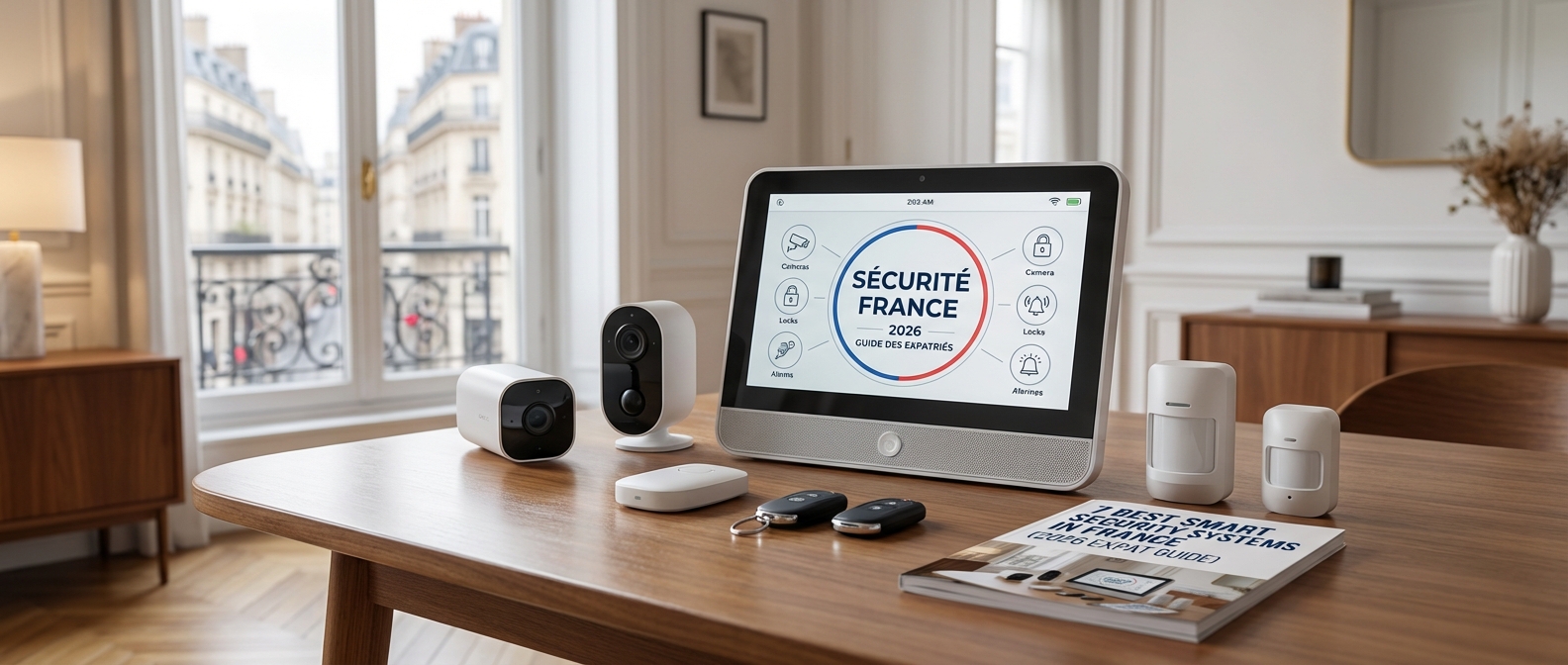
Introduction: Securing Your French Home in 2026
Introduction: Securing Your French Home in 2026
Navigating home security France as an expat requires more than just buying a camera; it demands a strategy tailored to local infrastructure, thick stone masonry, and strict privacy laws. Whether you are protecting a primary residence in Paris or a holiday home in Provence, understanding regional risks is the first step toward true expat safety. In 2026, the market has shifted from traditional wired alarms to sophisticated, AI-driven ecosystems that function even in remote areas with spotty internet.
Burglary prevention France statistics reveal a divided landscape. High-density zones like Île-de-France (Paris) and the PACA region (French Riviera) continue to face higher break-in rates, necessitating rapid-response professional monitoring. Conversely, rural properties in regions like the Dordogne face a different threat: isolation. Here, police response times are longer, making active deterrence—such as loud sirens and floodlights—critical for stopping intruders before they breach the perimeter.
This guide analyzes systems based on three non-negotiable criteria for 2026:
- Connectivity: Capability to bypass thick stone walls (common in French farmhouses) and utilize 5G backups.
- Compliance: Adherence to French laws regarding public space surveillance and GDPR data privacy.
- Language Support: App interfaces and customer service available in English.
For families managing a busy household, integrating these systems provides essential oversight. For a deeper look at how automation alleviates parental stress, read The Ultimate Peace of Mind: 9 Smart Home Security Benefits for Mothers (2026 Guide).
French Property Security Challenges (2026)
The following table outlines specific hurdles expats face when securing French real estate and the modern solutions available this year.
| Challenge | Local Context | 2026 Smart Solution |
|---|---|---|
| Thick Masonry | Traditional stone walls (50cm+) block standard Wi-Fi signals. | Mesh & LoRaWAN: Systems using sub-GHz frequencies (like LoRa) or advanced Mesh Wi-Fi 7 to penetrate stone. |
| Strict Privacy Laws | Illegal to film public streets or neighbors' property; strict signage rules. | Privacy Masking: AI cameras that automatically blur public zones to ensure legal compliance. |
| Power Stability | Rural areas often experience storm-related outages. | Cellular Backup: Hubs with built-in 4G/5G SIM cards and extended battery lives (up to 24h). |
| Vacant Properties | High risk for "squatters" or burglaries during off-seasons. | Smart Simulation: Lighting and shutter routines that mimic presence remotely. |
If you are also looking to optimize your utility usage while away, consider pairing your security setup with climate control. See our review of the 5 Best Smart Thermostats for Families in France: The 2026 Expat Guide.
Critical Things to Know Before Buying a Security System in France
Critical Things to Know Before Buying a Security System in France
Installing a security system in France involves more than sticking cameras to a wall; strict privacy codes and distinct architectural challenges dictate your setup. You must comply with CNIL regulations, strictly limit footage to your private property boundaries, and inform any domestic staff of surveillance. Furthermore, France's prevalence of thick stone masonry often necessitates specialized mesh networks or Zigbee hubs rather than standard Wi-Fi solutions found in US drywall construction.
1. Navigating CNIL Regulations and Privacy Laws
France enforces some of the strictest data protection laws in the world. The Commission Nationale de l'Informatique et des Libertés (CNIL) governs how you capture and store footage. Unlike in the US, where surveillance is often treated casually, French privacy laws prioritize the individual's right to privacy over property surveillance.
- Private Property Only: You have the right to film the interior of your home and your private garden. You generally do not need to register the device with the CNIL if it is strictly for private, domestic use.
- The Public Space Ban: You absolutely cannot film public spaces. This includes the sidewalk in front of your house, the street, or your neighbor's driveway. If your camera’s field of view spills onto the street, you must configure "privacy zones" (blackout areas) within the camera's software.
- Domestic Staff Rights: If you employ a nanny, cleaner, or home health aide, you legally must inform them that cameras are present. You cannot film them continuously during their work duties, and you certainly cannot film them in private areas like a bathroom or a live-in bedroom.
For a broader look at how to balance safety with family needs, read The Smart Mom’s Guide to Family Home Security: Best Systems & Tips for 2026.
2. Outdoor Camera Laws in France
Outdoor camera laws in France create specific hurdles for video doorbells and exterior floodlight cameras. Because many French homes (especially townhouses) open directly onto the pavement, installing a video doorbell requires precision.
If your doorbell captures the faces of passersby on the public street, you are in violation of the law. You must choose a system that offers:
- Granular Motion Zones: To ignore street traffic.
- Privacy Masking: To permanently block out the neighbor’s fence or the public road.
3. The "Stone Wall" Infrastructure Challenge
Expats often underestimate French architecture. While modern apartments use concrete, many desirable homes feature thick stone walls (pierre de taille) or reinforced concrete that acts as a Faraday cage, killing Wi-Fi signals instantly.
- Wi-Fi Cameras Struggle: A standard Wi-Fi camera placed on an exterior stone wall will likely disconnect frequently.
- The Hub Solution: Systems using lower-frequency protocols like Z-Wave or Zigbee (such as Ring or Abode) penetrate stone walls better than 5GHz or 2.4GHz Wi-Fi.
- Mesh is Mandatory: If you rely on Wi-Fi cameras, you will almost certainly need a mesh Wi-Fi system to push the signal through French masonry.
If you are unsure which central unit handles these connection protocols best, review our analysis in The Smart Mom’s Guide: Best Smart Home Hubs Compared (2026 Review).
4. Renter Constraints (Locataires)
Drilling holes in the exterior facade of a French apartment building (copropriété) is usually forbidden without a vote from the HOA (syndic). Even inside, French landlords are notoriously strict regarding the état des lieux (move-out inspection).
- Adhesive over Drills: Prioritize systems that use 3M command strips or strong adhesives.
- Battery over Wired: Hardwiring a doorbell often requires electrical certification. Battery-powered units avoid legal headaches with landlords.
Quick Comparison: US vs. France Security Norms
| Feature | US Standard Practice | French Legal Requirement |
|---|---|---|
| Sidewalk Filming | Generally legal (public space). | Strictly Illegal. Must mask public areas. |
| Employee Monitoring | Permitted (state dependent). | Restricted. Must notify staff; cannot film continuously. |
| Data Storage | Cloud storage is standard. | GDPR Compliance Required. Data servers usually must be in EU. |
| Signage | Optional deterrent. | Mandatory if filming implies public access or staff presence. |
| Wall Material | Drywall/Wood (Wi-Fi friendly). | Concrete/Stone (Wi-Fi hostile). |
5. Siren Duration Limits
While not always strictly policed in rural areas, many French municipalities have noise ordinances regarding alarm sirens. An external siren that rings for 30 minutes is considered a disturbance of the peace (tapage nocturne or diurne). Most compliant systems sold in France automatically cut the siren after 3 to 5 minutes to comply with local noise regulations while still alerting the neighborhood.
CNIL and Privacy Laws: What You Can and Can't Film
CNIL and Privacy Laws: What You Can and Can't Film
In France, homeowners are legally permitted to film only within the private boundaries of their property, such as the interior of the house or a private garden. Filming public space, including sidewalks, streets, or a neighbor's property, is strictly prohibited. The CNIL (Commission Nationale de l'Informatique et des Libertés) enforces these regulations rigidly to protect individual privacy, requiring that any security camera capturing public areas must have those zones digitally masked or physically re-angled.
The Public Space Rule
Expats often unknowingly violate French law by installing video doorbells that record the street. Unlike in the US or UK, where public recording is often tolerated, France prioritizes the "right to image." If your camera captures a passerby on the sidewalk, you are liable. Most modern systems allows you to set "privacy zones" to blackout these areas. Failure to comply can result in significant fines if a neighbor or pedestrian files a complaint.
Employee Privacy and "Nanny Cams"
Employing home staff, such as cleaners or nannies, introduces complex employee privacy obligations. While you utilize security for peace of mind—a concept we explore further in The Smart Mom’s Guide to Family Home Security: Best Systems & Tips for 2026—you cannot use cameras to place employees under constant surveillance.
The CNIL stipulates the following for home employers:
- Notification: You must inform the employee that cameras are present and indicate their location. ideally, this should be written in the employment contract.
- Proportionality: You cannot film an employee continuously while they work. Filming is allowed to secure the premises, not to monitor the worker's performance minute-by-minute.
- Private Areas: Cameras are strictly forbidden in bathrooms, toilets, or live-in staff bedrooms.
Quick Guide: French Surveillance Legality
| Surveillance Action | Legal Status | CNIL Requirement |
|---|---|---|
| Filming your private garden | ✅ Legal | No specific declaration needed for private use. |
| Filming the street/sidewalk | ❌ Illegal | You must configure privacy masking to block these areas. |
| Filming a nanny continuously | ❌ Illegal | Surveillance cannot be permanent; it is deemed harassment. |
| Storing footage | ✅ Legal | data implies a secure storage limit (usually 30 days max). |
| Hidden cameras | ❌ Illegal | Using covert devices to film staff without consent is a criminal offense. |
Connectivity: Fiber, ADSL, and Stone Walls
French architecture presents a unique adversary to modern smart homes: the 50-centimeter stone wall. While aesthetically charming, the dense masonry found in traditional maisons and Haussmann apartments acts as a formidable barrier to wireless signals. If you rely solely on Wi-Fi cameras placed on the exterior of a stone farmhouse, you will likely experience connection dropouts, frozen feeds, and critical security gaps.
Thick walls wifi issues require a strategic shift away from direct-to-Wi-Fi devices. Standard 2.4GHz and 5GHz Wi-Fi signals struggle to penetrate solid stone or reinforced concrete. Instead, prioritize security systems that utilize low-frequency protocols like Z-Wave or Zigbee. These radio frequencies operate below 1GHz, allowing them to punch through dense materials more effectively than standard Wi-Fi.
For a robust setup, a central hub is non-negotiable. This acts as the brain of your operation, bridging the gap between your sensors and your internet connection. For a deeper dive into hardware options, read our guide on the Best Smart Home Hubs Compared (2026 Review).
Protocol Performance in French Housing
Understanding how different signals interact with masonry is vital for your installation strategy.
| Protocol | Frequency | Wall Penetration | Best Use Case |
|---|---|---|---|
| Wi-Fi (5GHz) | High | Poor | Streaming video in the same room as the router. |
| Wi-Fi (2.4GHz) | Medium | Moderate | General connectivity; struggles with multiple stone walls. |
| Zigbee | Medium | Moderate | Sensors and lights; creates a mesh network to hop around obstacles. |
| Z-Wave | Low | Excellent | Door sensors and locks separated by thick internal/external walls. |
| Thread | Medium | Good | New standard (Matter); offers self-healing mesh capabilities. |
Navigating French ISPs
Your security system is only as good as the pipe connecting it to the cloud. French ISP compatibility is generally high, but hardware limitations exist. Major providers like Orange, Free, SFR, and Bouygues Telecom supply proprietary routers (Box Internet).
While the Orange Livebox 7 (and newer 2026 iterations) offers Wi-Fi 7, the signal strength is capped by EU regulations, meaning it will not cover a three-story stone house unaided.
- Fiber (La Fibre): Now available in over 90% of France. It provides the upload speeds required for 2K and 4K cloud recording.
- ADSL/VDSL: Still common in deep rural areas ("zones blanches"). If you are on ADSL, avoid continuous recording cameras (CVR); opt for event-based recording to prevent bandwidth saturation.
- 4G/5G Backup: In rural France, storms frequently knock out overhead telephone lines. Ensure your security base station includes a cellular backup slot or a battery backup to maintain protection during outages.
Connectivity Tips for the Expat Home:
- Install a Mesh System: Disable the Wi-Fi on your ISP box and install a dedicated Mesh system (e.g., Eero, Orbi). Place satellites within line-of-sight of each other to "guide" the signal around stone barriers.
- Wired Backhaul: Whenever possible, use Ethernet cables or Powerline adapters (CPL) to connect cameras or mesh points through the electrical wiring, bypassing the stone walls entirely.
- Check Upload Speeds: Run a speed test. You need at least 2 Mbps upload speed per HD security camera.
- Hub Placement: Centralize your hub. Do not hide it in a metal electrical cabinet; this creates a Faraday cage that blocks all signals.
Ensuring a stable connection is the foundation of family safety. For a broader look at how these systems protect your household, check out The Smart Mom’s Guide to Family Home Security: Best Systems & Tips for 2026.
Top Smart Security Systems in France for 2026: The Breakdown
Top Smart Security Systems in France for 2026: The Breakdown
Navigating the landscape for the best security system France 2026 offers requires choosing between full-service professional monitoring and flexible DIY smart ecosystems. The market is currently split between high-end French providers like Verisure and Somfy, and agile, English-friendly tech giants like Ring and Eufy. Your choice depends entirely on whether you prioritize 24/7 police dispatch or zero monthly fees.
Here is a quick comparison of the top contenders available in France this year:
| System | Best For | Est. Monthly Cost | Installation |
|---|---|---|---|
| Verisure | Professional Monitoring | €45 - €60+ (Quote based) | Professional |
| Ring Alarm | English Support & Integration | €10 (Ring Protect Plus) | DIY |
| Somfy Home Alarm | French Home Automation | Free (Optional €9.99 monitoring) | DIY |
| Netatmo | Privacy & Design | €0 (No subscription) | DIY |
| Eufy Security | Budget & Battery Life | €0 (No subscription) | DIY |
1. Verisure
Verdict: Best for Professional Monitoring & "Set It and Forget It"
If budget is secondary to absolute safety, Verisure remains the heavyweight champion in France. They operate on a closed ecosystem, meaning you cannot mix and match third-party sensors, but the reliability is unmatched. Their "Fog Barrier" (Brouillard Anti-Cambriolage) is a standout feature that physically obscures a burglar's vision within seconds of a break-in.
- Why it wins: They handle everything. From installation to 24/7 monitoring by Securitas Direct, this is the smart home alarm France relies on for high-stakes security.
- The Expat Factor: While their hardware is top-tier, customer service is predominantly French. You will likely need a decent grasp of the language to navigate contracts.
- Cost: High. Expect upfront hardware costs plus a monthly contract often exceeding €50.
2. Ring Alarm (Gen 3)
Verdict: Best for English Support & Smart Home Integration
For expats, Ring is often the default choice. The hardware is readily available on Amazon.fr, but the app interface can be set entirely to English. It is arguably the most user-friendly DIY system for those already embedded in the Amazon ecosystem. If you are debating voice assistants to pair with this, check our breakdown of Alexa vs. Google Home for Families (2026) to see why Ring fits the Alexa ecosystem so seamlessly.
- Key Features:
- Assisted Monitoring: For roughly €10/month, the Ring Protect Plus plan offers cellular backup and assisted monitoring (automated calls to emergency contacts), though it does not dispatch French police directly.
- Flexibility: No long-term contracts. You can cancel the subscription anytime.
- Cost: Hardware kits start around €250; subscription is €10/month.
3. Somfy Home Alarm
Verdict: Best for French Home Integration (Shutters & Gates)
Somfy is a French institution. If you are renting or buying a house in France with electric shutters (volets roulants), chances are they utilize Somfy motors. Their security system integrates natively with these elements. When the alarm triggers, the system can automatically lower your shutters to secure the house.
- Why it matters: This integration is vital for efficiency. Combining security with automation is also a key strategy in Smart Home Energy Saving for Families, as managing shutters actively reduces heating bills.
- IntelliTAG: Their patented door/window sensors analyze vibration to trigger the alarm before an intruder breaches the door.
- Cost: Hardware kits range from €300–€500. Optional professional monitoring is available for €9.99/month without a long-term commitment.
4. Netatmo Smart Alarm System
Verdict: Best for Privacy & Facial Recognition
Netatmo, another French brand, prioritizes design and data privacy. Unlike Ring or Verisure, Netatmo stores data locally on an SD card, meaning no footage is uploaded to the cloud unless you want it to be. There are absolutely no subscription fees.
- The Tech: The indoor camera features excellent facial recognition. It knows the difference between your toddler and a stranger, reducing false alarms—a crucial feature we discuss in The Smart Mom’s Guide to Family Home Security.
- Drawback: It is a piecemeal system. You buy the camera, siren, and sensors separately, which can drive up the initial price.
- Cost: €0 monthly fees. Full setup hardware costs approx. €350–€450.
5. Eufy Security (eufyCam 3)
Verdict: Best for Battery Life & 4K Resolution
Eufy is the strongest competitor to Netatmo for those refusing to pay monthly subscriptions. The standout feature here is the battery life; the eufyCam 3 cameras feature integrated solar panels, theoretically offering "Forever Power" with just two hours of sunlight daily—highly effective even in northern France.
- Storage: The HomeBase 3 acts as a local storage hub with expandable memory (up to 16TB), ensuring you never pay for cloud storage.
- Resolution: It offers 4K video, providing much clearer evidence than the standard 1080p found in Ring or Somfy standard kits.
- Cost: €0 monthly fees. High upfront cost for the kit (€500+), but zero recurring costs.
1. Verisure: The Heavyweight Champion (Best for Professional Monitoring)
1. Verisure: The Heavyweight Champion (Best for Professional Monitoring)
Verisure is the undisputed giant of the French home security market, boasting a ubiquity that rivals utility companies. Born from the heritage of Securitas Direct, this system is not a gadget you pick up at a hardware store; it is a full-service security ecosystem designed for homeowners who demand zero involvement in the technical setup. If your priority is outsourcing safety to professionals rather than tinkering with Wi-Fi bridges, Verisure is the default choice in 2026.
The Power of Télésurveillance
The core value proposition here is télésurveillance (remote monitoring). Unlike DIY systems where a siren blares and you receive a frantic push notification, Verisure connects your home to a 24/7 response center. If an intrusion is detected, agents verify the threat via cameras and audio channels. They can deploy a private security guard or contact the Gendarmerie on your behalf.
This level of service offers significant relief for expats navigating French bureaucracy during emergencies. For a deeper dive into how professional monitoring supports parenting, check our guide on The Ultimate Peace of Mind: 9 Smart Home Security Benefits for Mothers.
Standout features include:
- ZeroVision Fog Barrier: In confirmed break-ins, the system pumps the room full of dense, non-toxic fog, physically blinding intruders until authorities arrive.
- Professional Installation: A technician assesses vulnerable entry points and installs the hardware. No drilling or pairing required on your part.
- SOS Button: Immediate connection to the monitoring center for medical or security emergencies.
The Cost of Convenience
Excellence comes with a premium price tag and rigid terms. Verisure France reviews frequently cite the difficulty of cancelling contracts as a major pain point. The business model relies on hardware rental and monthly subscriptions that can escalate quickly depending on the number of sensors. Furthermore, the sales tactics are notoriously aggressive; expect high-pressure upselling during the initial home assessment.
Verisure at a Glance
| Feature | Specification |
|---|---|
| Best For | Hands-off homeowners & expats seeking full-service protection. |
| Monitoring Type | 24/7 Professional Télésurveillance (Securitas Direct legacy). |
| Installation | Professional technician required (No DIY). |
| Contract Terms | Long-term contracts (12-36 months); strict cancellation policies. |
| Key Tech | ZeroVision Fog, Shock Sensors, Photo Detectors. |
| App Quality | High (My Verisure), but limited smart home integration compared to DIY rivals. |
Verdict: Choose Verisure if you want a "fortress" approach and are willing to pay a monthly premium to never worry about false alarms or calling the police yourself. Avoid it if you prefer owning your equipment outright or want the flexibility to switch providers next month.
2. Somfy: The Local Tech Hero (Best for Smart Home Integration)
2. Somfy: The Local Tech Hero (Best for Smart Home Integration)
Somfy is not merely a brand in France; it is a staple of French housing infrastructure. Born in the Haute-Savoie region, this giant of French tech bridges the gap between mechanical home automation and digital security. If your French residence comes equipped with motorized volets roulants (rolling shutters), there is a statistically high probability they run on Somfy motors. For expats, choosing Somfy means betting on the home team, ensuring high compatibility with existing hardware found in French properties.
The "Fortress" Effect: Electric Shutters Integration
Somfy’s dominance unlocks a specific security feature that foreign competitors like Ring or Google cannot easily match: native electric shutters integration.
Through the Somfy Protect ecosystem, your security system does more than trigger a siren; it physically fortifies your home. When the proprietary IntelliTAG vibration sensor detects a break-in attempt on a window, the system automatically lowers the shutters immediately. This creates a physical barrier against the intruder before they even breach the glass. This level of automation turns a passive alarm into an active defense system, providing one of the most tangible smart home security benefits for mothers available on the market today.
The TaHoma Ecosystem
The brain behind this operation is the TaHoma switch. This smart hub centralizes control for your alarm, lighting, and even heating systems. It allows you to create "scenarios"—for example, a "Night Mode" that arms the perimeter alarm, lowers all shutters, and adjusts the temperature. If you are looking to optimize your climate control alongside security, Somfy pairs exceptionally well with the best smart thermostats for families in France.
Somfy Protect System Overview:
| Feature | Specification |
|---|---|
| Ecosystem Hub | TaHoma Switch (supports Zigbee 3.0, RTS, io-homecontrol) |
| Key Sensor | IntelliTAG (Patented vibration & opening sensor) |
| Privacy | Cameras feature a mechanical privacy shutter (closes physically) |
| Connectivity | Wi-Fi, Radio redundancy (LoRa network backup available) |
| Subscription | Optional (Basic features are free; Pro monitoring is paid) |
| Voice Control | Compatible with Alexa, Google Assistant, Apple HomeKit |
Why Choose Somfy in 2026?
- Preventative Security: The IntelliTAG analyzes vibrations to trigger alarms before the door is forced open.
- Privacy First: Their indoor cameras have a mechanical shutter that physically covers the lens when you are home, ensuring absolute privacy—a feature appreciated by privacy-conscious parents.
- Resale Value: Because Somfy is the standard in France, hardwiring these systems into a property can increase its appeal to future French buyers.
Pros & Cons
- Pros: unparalleled integration with French motorized shutters; local customer support; highly reliable sensors; system works even if Wi-Fi cuts out (via LoRa backup).
- Cons: The hardware price point is higher than US-based DIY systems; the app interface, while functional, is less sleek than Google or Apple interfaces.
3. Netatmo: The Design-First Choice (Best No-Subscription Option)
3. Netatmo: The Design-First Choice (Best No-Subscription Option)
Netatmo stands out in the French market by rejecting the industry-standard subscription model entirely, offering a sophisticated security ecosystem that stores data locally rather than in the cloud. For expats seeking a "set it and forget it" solution without monthly overhead, this French brand delivers high-end hardware that blends seamlessly into modern decor while prioritizing user privacy.
The "No Fees" Advantage
The primary draw here is financial and ethical. Unlike competitors that lock essential features behind a paywall, Netatmo grants full access out of the box. You get no subscription fees, unlimited video downloads, and full feature availability from day one. All footage is stored locally on an encrypted microSD card included with the device, ensuring that your private moments stay within your walls. This approach aligns perfectly with The Ultimate Peace of Mind regarding data privacy.
Intelligent Facial Recognition
The flagship indoor camera, the Netatmo Welcome, utilizes proprietary artificial intelligence to distinguish between family members and intruders.
Instead of bombarding you with generic motion alerts every time a teenager walks into the kitchen, the system identifies the face. You receive a precise notification: "John has arrived home." If it detects an unknown face, you are alerted immediately with a video clip and a photo of the stranger. This drastically reduces "notification fatigue," a common issue with cheaper sensors.
Netatmo Security Ecosystem Specs
| Feature | Specification |
|---|---|
| Video Quality | Full HD 1080p |
| Field of View | 130° (Indoor) / 100° (Outdoor) |
| Storage | Encrypted MicroSD (Local) + Optional Dropbox/FTP backup |
| Connectivity | Wi-Fi 802.11 b/g/n (2.4 GHz) |
| Smart Integration | Apple HomeKit, Google Assistant, Alexa |
| Night Vision | Infrared (Indoor) / Infrared + Spotlight (Outdoor) |
| Monthly Cost | €0.00 |
Design and Integration
Netatmo hardware is anodized aluminum, looking more like high-end audio equipment than surveillance gear. It is designed to be seen. Furthermore, the ecosystem is robust. If you are already optimizing your French utility bills with their heating solutions—check our guide on 5 Best Smart Thermostats for Families in France—the security cameras integrate into the same app interface for centralized control.
Why Expats Choose Netatmo:
- Privacy First: Footage is yours. It isn't sitting on a server in Silicon Valley.
- Cost Effective: The higher upfront hardware cost is offset by no subscription fees within 12 to 18 months.
- Precision: Facial recognition technology minimizes false alarms.
- Apple HomeKit Secure Video: Fully compatible for users deep in the Apple ecosystem.
4. Ring & Google Nest: The Expats' Familiar Favorites
4. Ring & Google Nest: The Expats' Familiar Favorites
For expats relocating to France, minimizing culture shock is a priority. Ring and Google Nest dominate the market because they offer immediate familiarity. These systems guarantee a native English user interface and seamless integration with existing accounts, bypassing the language barrier often found in French-centric competitors like Somfy or Netatmo.
However, you must exercise caution regarding hardware compatibility. Do not bring your US security devices to France. Ring Alarm France systems operate on European Z-Wave frequencies distinct from North American models; your US sensors simply will not connect to a French base station. Similarly, while many Google Nest Cam France units are dual-voltage, plug shapes differ, and older wired US hardware may overheat on Europe’s 220V standard. Always purchase your equipment locally (via Amazon.fr or Darty) to ensure regulatory compliance and valid warranties.
Feature Comparison: Ring vs. Google Nest in France
| Feature | Ring (Amazon) | Google Nest |
|---|---|---|
| Best For | Whole-home perimeter security & DIY alarm kits. | Intelligent video monitoring & AI object detection. |
| Ecosystem | Deep integration with Amazon Alexa. | Native control via Google Assistant/Home App. |
| Subscription | Ring Protect (approx. €10/month) covers all devices. | Nest Aware (approx. €6-12/month) based on history length. |
| Privacy | Data often processed in US; GDPR compliant but less strict than EU brands. | High data collection; strong encryption but tied to Google ad profile. |
| Installation | Simple DIY; Peel-and-stick sensors. | DIY; some wired floodlight cams require electrical work. |
Why Choose Ring?
Ring remains the most accessible entry point for comprehensive home security. The Ring Alarm France kits are modular, making them ideal for renters in Paris or Lyon who cannot drill holes in walls. The primary advantage is the "Ring Protect Plus" plan, which offers cellular backup and assisted monitoring options at a fraction of the cost of traditional French security firms like Verisure. If your household runs on Echo devices, the synergy is unbeatable. For a deeper look at how these ecosystems stack up, read our comparison on Alexa vs. Google Home for Families (2026).
Why Choose Google Nest?
If video quality and AI intelligence are your priorities, the Google Nest Cam France lineup is superior. The cameras distinguish between packages, animals, and unfamiliar faces with remarkable accuracy, reducing false alarms—a crucial feature for busy parents. The Google Home app aggregates your thermostat, lights, and cameras into a single dashboard. While the hardware is pricier, the design aesthetic blends better with modern European interiors than Ring’s utilitarian plastic.
Pros:
- Language First: No need to navigate French technical terms; the apps default to your phone's language settings.
- Portability: Wireless sensors and cameras are easy to uninstall and move to your next apartment.
- Availability: Accessories and add-ons are available at almost every French electronics retailer.
Cons:
- Privacy Concerns: Unlike European companies (like Netatmo), Amazon and Google transfer significant data to US servers, which concerns some privacy-focused users in the EU.
- Subscription Fatigue: Advanced features like familiar face detection or video history require monthly fees in Euros.
5. Homiris (EPS): The Bank-Backed Option
5. Homiris (EPS): The Bank-Backed Option
Homiris operates on a distinct "service-first" rental model where you pay a monthly subscription for hardware and EPS monitoring, rather than purchasing equipment upfront. If you have recently opened an account with Crédit Mutuel or CIC, your advisor likely pitched this system. It is ideal for expats who prefer professional installation and zero maintenance over owning the latest tech gadgets.
The Bank Connection and Rental Model
Unlike DIY options such as Ring or Eufy, Homiris is a heavy hitter in the French market due to its affiliation with major banking institutions. You will frequently encounter bank security offers bundled with home insurance or checking accounts.
The critical distinction here is ownership. You do not own the cameras or sensors. You are essentially leasing peace of mind. If you cancel your contract, a technician retrieves the gear. This model eliminates the risk of obsolete hardware, as the company replaces faulty batteries and sensors at no extra cost. However, it also means your monthly payments never cease, and you cannot take the system with you to a new country unless you transfer the service within France.
Is It Smart Enough?
Homiris systems are robust but utilitarian. They prioritize verified intruder alerts over smart home automation. You won't find complex IFTTT routines or seamless integration with every smart bulb in your nursery. However, the system does offer a functional app for remote arming and checking sensor status.
For families seeking a broader ecosystem that integrates safety with daily convenience, you might want to compare this strictly monitored approach with more flexible setups in our Smart Mom’s Guide to Family Home Security.
Homiris (EPS) vs. DIY Ownership
| Feature | Homiris (EPS) | DIY Systems (Ring/Arlo/Netatmo) |
|---|---|---|
| Equipment Cost | €0 (Included in sub) | €200 - €800+ (Upfront) |
| Ownership | Rental (Must return) | You keep it forever |
| Installation | Professional Technician | Self-Install |
| Monitoring | 24/7 Professional Center | Self-monitor (Pro optional) |
| Maintenance | Included (Batteries/Fixes) | At owner's expense |
| Commitment | 12-Month Contract (Typical) | None |
Why Choose Homiris?
While online Homiris reviews are polarized—often praising the responsiveness of the EPS monitoring center while criticizing strict cancellation policies—the service remains a top contender for a specific demographic.
- Professional Intervention: If an alarm triggers, EPS verifies the threat via audio/video and calls the police or sends a guard (depending on your tier).
- Hassle-Free Maintenance: No climbing ladders to change detector batteries; they handle it.
- Smoke Detection: Monitored smoke detectors alert the center even if you aren't home.
If you are renting a property in France for a few years and want immediate security without investing in hardware you'll eventually have to sell, this is the pragmatic choice.
Buying Guide: Choosing the Right System for Your French Property
Buying Guide: Choosing the Right System for Your French Property
Selecting the optimal security setup for a French property requires balancing connectivity reliability, installation flexibility, and language support. For 2026, renters in urban centers should prioritize wireless, contract-free DIY kits that require no drilling, while homeowners in rural maisons must insist on systems with long-range radio frequencies and cellular backup to penetrate thick stone walls and combat spotty internet coverage.
Assess Your Connectivity and Infrastructure
France offers a dichotomy of infrastructure: blazing fast fiber in cities and unpredictable ADSL or 4G/5G in the countryside. Before purchasing, run a speed test in the specific rooms where cameras will live.
- The Stone Wall Problem: Many French farmhouses and older buildings utilize thick stone masonry. Standard WiFi (2.4GHz or 5GHz) struggles to penetrate these structures. If you live in a stone house, avoid pure WiFi cameras. Instead, opt for a system using a Hub with low-frequency protocols (like Z-Wave, Zigbee, or proprietary radio) which punch through stone more effectively.
- Power Stability: Thunderstorms in regions like the Dordogne or Provence frequently cut power. A robust security system comparison will always highlight battery backup. Ensure your hub has at least 12 hours of auxiliary power.
Match the System to Your Housing Scenario
Your living situation dictates your hardware limits. Landlords in France are notoriously strict regarding property modifications. Use this matrix to identify your hardware category.
| Housing Scenario | Installation Type | Critical Technology | Priority Feature |
|---|---|---|---|
| Parisian Apartment (Rent) | DIY / Peel-and-Stick | WiFi + Battery Power | Portability. Must be easy to remove when you move. |
| Rural Farmhouse (Own) | Hybrid / Pro Install | Long-Range Radio (868 MHz) | Signal Penetration. Must work through 50cm stone walls. |
| Suburban Villa (Own) | Hardwired (PoE) | Ethernet + NVR | Continuous Recording. 24/7 localized video storage. |
| Second Home / Holiday Let | DIY with Monitoring | 4G/LTE Backup Sim | Remote Management. Ability to reset/check via app from abroad. |
The "Expat Factor": Language and Monitoring
For non-francophones, the user interface is the most critical component of this buying guide. While hardware is universal, software is not.
- App Language: Verify the app interface supports English natively. Some local French legacy providers offer excellent hardware but strictly French software, making emergency navigation stressful.
- Professional Monitoring: If you opt for a subscription service (télésurveillance), ensure the monitoring center has English-speaking operators. In a panic situation, trying to recall high-school French vocabulary is a safety risk.
- Customer Support: Check if the helpdesk operates 24/7 or only during French business hours (often closing for lunch).
Integration for the "Smart Mom"
Security shouldn't stand alone. It needs to work with your existing ecosystem to truly reduce your mental load.
- Visual Verification: Look for systems that integrate with smart displays. Being able to ask your assistant to "show me the front door" is vital when your hands are full. For a deeper dive into how these assistants help manage the household, read our guide on The Invisible Village: 9 Life-Changing Benefits of a Smart Assistant for Moms.
- Child Safety Loops: Modern sensors do more than catch burglars; they keep toddlers safe. Door contact sensors can alert you if a curious child opens a basement door or window. This proactive approach is essential for peace of mind. You can find more specific strategies in our article on Smart Home Safety for Kids: The Ultimate Protection Guide.
The Contract Trap
French bureaucracy is legendary. Canceling contracts can often require registered letters (lettre recommandée) and months of notice.
- Avoid: 12 to 24-month lock-in contracts common with traditional providers like Verisure or Homiris unless you are permanently settled.
- Prefer: Month-to-month rolling contracts or self-monitored systems (Ring, Eufy, Ajax) where you own the hardware outright. This flexibility is crucial for expats who may face unexpected relocation.
Self-Monitoring vs. Télésurveillance (Remote Monitoring)
Self-Monitoring vs. Télésurveillance (Remote Monitoring)
The primary distinction lies in who takes action during an alarm trigger. Self-monitoring places the entire burden on the homeowner: you receive a smartphone notification and must verify the threat and contact authorities yourself. Télésurveillance is a paid subscription service where professional agents verify video feeds (levée de doute) and directly coordinate the police intervention France requires for confirmed break-ins.
The Realities of Self-Monitoring
In a self-monitored setup, your smartphone is your command center. When a sensor trips, you get a ping. You must open your app, view the live feed, and decide if it is a burglar or the cat. If it is a threat, you must dial 17 (Police/Gendarmerie) or 112.
- Pros: Zero monthly fees; you maintain total privacy.
- Cons: If your phone is on "Do Not Disturb," or if you are on a flight without Wi-Fi, the alert goes unnoticed. The mental load is entirely yours.
For parents juggling busy schedules, relying solely on notifications can be stressful. For a broader look at protecting your household ecosystem, read The Smart Mom’s Guide to Family Home Security: Best Systems & Tips for 2026.
Télésurveillance: The French Standard
In France, Télésurveillance is more than a convenience; it is a strategic bridge to law enforcement. French police generally do not respond to a simple ringing alarm due to the high volume of false positives. They require visual or audio confirmation of a crime in progress.
When your system triggers:
- The security center receives the alert immediately.
- An agent accesses the camera or motion sensor images (strictly during the alarm event) to perform a verification.
- If an intruder is confirmed, they access a priority line to dispatch the Gendarmerie or Police Nationale immediately.
While the remote monitoring cost adds a monthly expense—typically between €15 and €50 depending on the provider—it guarantees a response even if you are asleep or out of the country.
Comparison: Which is Right for You?
| Feature | Self-Monitoring (DIY) | Télésurveillance (Pro) |
|---|---|---|
| Monthly Cost | €0 (Free) | €15 - €50+ / month |
| Verification | You check camera feeds manually. | Professional agent checks feeds instantly. |
| Police Action | You must call 17 or 112. | Agent calls via priority police line. |
| False Alarms | You handle it (annoying neighbors). | Agent filters them (avoids police fines). |
| Hardware | Usually bought upfront. | Often rented or subsidized. |
| Best For | Tech-savvy users; budget conscious. | Frequent travelers; high-security needs. |
If you opt for Télésurveillance, ensure the company holds an APSAD certification (specifically type P3 for high risk or P2 for standard residential), which guarantees their response times meet French insurance standards.
Insurance Discounts and A2P Certification
Insurance Discounts and A2P Certification
Securing your home in France involves more than just installing cameras; it requires strictly adhering to French home insurance requirements. Most standard assurance habitation policies mandate that your locks and alarm systems meet A2P certification standards to guarantee a full payout in the event of a burglary. If your smart lock or alarm system lacks this specific certification, your insurer may legally reduce your compensation or void your claim entirely, regardless of the video evidence you provide.
Understanding the A2P Standard
A2P (Assurance Prévention Protection) is a quality label issued by the CNPP (Centre National de Prévention et de Protection). It tests the resistance of security equipment against aggressive intrusion attempts. For expats, this is a critical distinction: a "smart" system is not automatically a "compliant" system in the eyes of French underwriters.
The certification is categorized by "stars," indicating how long the hardware can withstand a forced entry attempt.
| Certification Level | Resistance Time | Typical Use Case |
|---|---|---|
| A2P * | 5 Minutes | Standard apartments and low-risk residential zones. |
| A2P ** | 10 Minutes | Ground-floor flats, single-family homes, or urban areas. |
| A2P *** | 15 Minutes | High-value properties, art collections, or isolated villas. |
The Expat "Smart" Trap
Many popular international smart home brands—particularly those imported from the US—do not pursue A2P certification because the testing process is expensive and specific to France. While a system might offer excellent features, installing non-certified gear can leave a coverage gap.
- Check the Fine Print: Review your insurance contract's "Conditions Générales." Look for clauses regarding "Moyens de protection exigés" (Required protection means).
- Hybrid Solutions: If your preferred smart lock isn't A2P certified, you may need to install a secondary, manual A2P deadlock to satisfy the insurer.
- Premium Discounts: Installing an A2P-certified alarm system often unlocks a 10% to 15% discount on your annual premium.
Achieving true security requires balancing modern convenience with regulatory compliance. For families looking to deepen their understanding of safety beyond just hardware, read our guide on The Ultimate Peace of Mind: 9 Smart Home Security Benefits for Mothers (2026 Guide). Always verify the certification logo on the packaging before purchase; if you don't see the A2P shield, assume it does not meet the standard.
Installation: DIY or Pro?
Installation: DIY or Pro?
Choosing between a DIY installation and hiring a professional installer in France depends largely on your housing type and technical confidence. DIY systems offer flexibility and lower upfront costs but often require drilling into typical French masonry walls. Conversely, professional services guarantee seamless setup and support but usually bind you to restrictive long-term monitoring contracts.
The Trade-Offs: Cost vs. Convenience
Most modern smart security suites sold in 2026 are marketed as "plug-and-play." However, expat residents often encounter a specific hurdle: French construction materials. Unlike US drywall, French homes frequently feature reinforced concrete (béton) or brick interior walls. The adhesive strips provided with standard DIY kits often fail on older plaster or textured wallpaper, necessitating a hammer drill and wall plugs (chevilles).
If you own your home and possess the right tools, DIY is the most cost-effective route. You retain full ownership of the equipment and avoid monthly fees unless you opt for cloud storage. For those renting or lacking tools, a professional service handles the hard work. Companies like Verisure or Homiris dominate the French market, but their business model relies on leasing the equipment to you through a subscription.
Here is a breakdown of the key differences to help you decide:
| Feature | DIY Installation (e.g., Ring, Eufy) | Professional Installer France (e.g., Verisure) |
|---|---|---|
| Upfront Cost | High (You buy the hardware) | Low or €0 (Subsidized hardware) |
| Monthly Cost | €0 - €10 (Optional storage) | €40 - €60+ (Mandatory contract) |
| Equipment Ownership | You own it forever | Often rented; returned upon cancellation |
| Installation Time | 2-5 hours (depending on drilling) | 1-2 hours (Done for you) |
| Contract Terms | None | Usually 12-36 months |
| Portability | Easy to move to a new home | Difficult; often requires contract transfer fees |
The "Hybrid" Approach: Hiring a Handyman
If you prefer the lower long-term cost of a DIY system but lack the desire to drill into concrete, you can hire a local handyman. In France, platforms like Travaux.com, AlloVoisins, or TaskRabbit allow you to find vetted tradespeople for small jobs.
This approach gives you the best of both worlds: you own the equipment without a contract, but you ensure the sensors are mounted securely and positioned correctly. Proper placement is vital for avoiding false alarms and keeping devices out of reach of children. For more insights on securing your home effectively, read The Smart Mom’s Guide to Family Home Security: Best Systems & Tips for 2026.
Key considerations for the hybrid route:
- Specify the Wall Type: When posting a job on a French platform, explicitly state if your walls are béton (concrete) or placo (drywall).
- Wi-Fi Strength: Ensure your router reaches the installation points before the handyman arrives.
- Power Sources: Verify if your outdoor cameras require hardwiring to the mains or simply need a rechargeable battery mount.
Conclusion: Which System Wins for 2026?
Conclusion: Which System Wins for 2026?
Selecting the ultimate smart security system France offers depends entirely on your residency status and technical comfort. Somfy dominates for homeowners wanting deep integration with existing French hardware, Ring and Google Nest lead for renters requiring portable English-language setups, and Verisure provides unmatched professional monitoring for those prioritizing maximum safety over monthly savings.
To help you decide quickly, compare the top contenders for 2026 below:
| System | Best For | Key Advantage | Installation Type |
|---|---|---|---|
| Somfy | Homeowners | Integrates with French electric shutters (volets roulants) | DIY or Professional |
| Ring / Google Nest | Renters & Expats | Portable, English native apps, zero contracts | 100% DIY |
| Verisure | High Security | 24/7 Guard Response & Fog Barriers | Professional Only |
The Local Powerhouse: Somfy
If you have purchased a permanent residence in France, Somfy is likely your best investment. Its TaHoma hub communicates flawlessly with the specific RTS and io-homecontrol protocols used by most French automated shutters and gates. This allows you to program "simulation of presence" routines where lights and shutters operate automatically while you travel.
The Expat Favorites: Ring & Google Nest
For those renting an apartment in Paris or a villa in Provence, flexibility is paramount. Ring and Google Nest require no drilling, move easily to your next address, and offer the most intuitive English interfaces.
Crucially, your choice here dictates your wider smart home ecosystem. If you are already invested in voice assistants, choosing the right security hardware is essential for a seamless experience. Read our breakdown of Alexa vs. Google Home for Families (2026): The Ultimate Mom-Tested Battle to ensure your security cameras talk to your smart displays.
The Heavy Hitter: Verisure
When the priority is absolute protection rather than home automation, Verisure stands alone. While the monthly fees are higher, the service includes rapid response teams and "ZeroVision" fog barriers that physically stop intruders. This is the preferred option for second homes that sit empty for months at a time.
Ready to secure your French home? Check the current pricing and starter kits for these systems on Amazon France or their respective official sites today.